

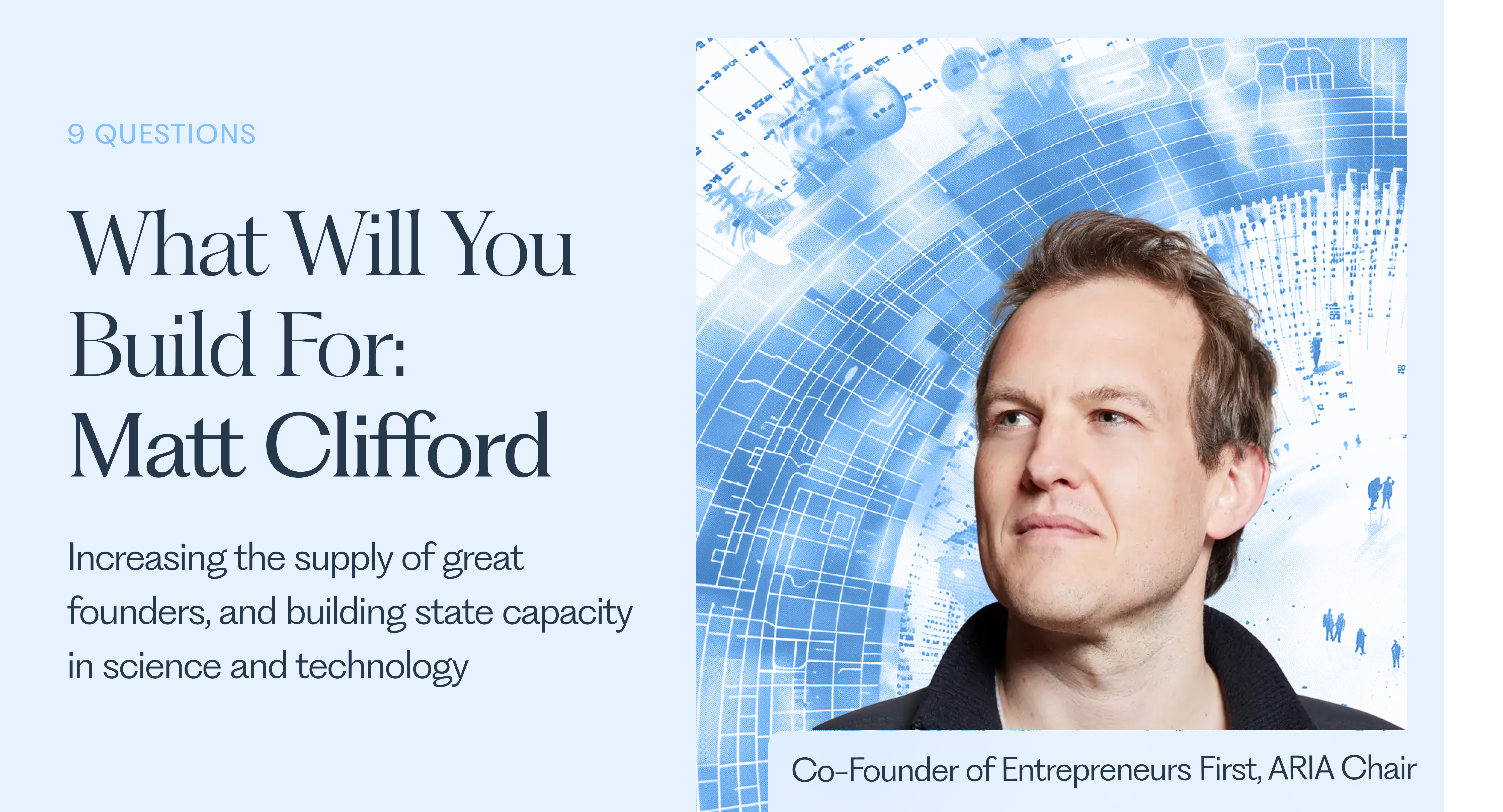
Every builder’s first duty is philosophical: to decide what they should build for. This series asks 9 questions to founders who are building towards their vision of the human good.
This week’s guest is Matt Clifford. Matt is the co-founder of Entrepreneurs First and the chair of ARIA – the UK’s Advanced Research & Invention Agency. He is the co-author of How to be a founder (with Alice Bentinck), serves on the board of Code First Girls, and writes open-source immersive murder mystery games.
1. What are the core questions or beliefs driving your work?
There are three:
That the emergence of powerful AI is the most important transition we will have to navigate in my lifetime.
That Britain has the potential to be a great country and force for good in the world.
That there may be a deep connection between the first two ideas - and that Britain achieving its potential may be one of the most important ways to shape the trajectory of AI for good.
2. What future are you building for?
I spent most of the last 15 years building Entrepreneurs First (EF), which aims to increase the supply of great founders - and therefore great companies - in the world.
Over the last four years, I’ve combined this with trying to build UK state capacity in science and technology generally, and AI specifically - first as Chair of ARIA (the Advanced Research & Invention Agency - loosely, the UK’s take on DARPA), then as AI adviser to PMs Rishi Sunak and Keir Starmer.
In the latter roles I helped create the UK’s AI Security Institute (AISI), convened the first AI Safety Summit and wrote the AI Opportunities Action Plan (the UK’s national AI strategy).
When I look across these roles, I think the thread that runs through is something like: I want to live in a world where as many humans as possible live in conditions of abundance with real freedom to shape the course of their lives.
3. What commonly held belief in the tech community do you believe is wrong?
I think many people in tech (at least implicitly) believe something like “we are our incentives” and therefore that various bad equilibria are inevitable. I think the opposite is true, but less comfortable: virtue is a real thing and that we can bend even very powerful forces by making the right choices.
4. What are your main philosophical influences?
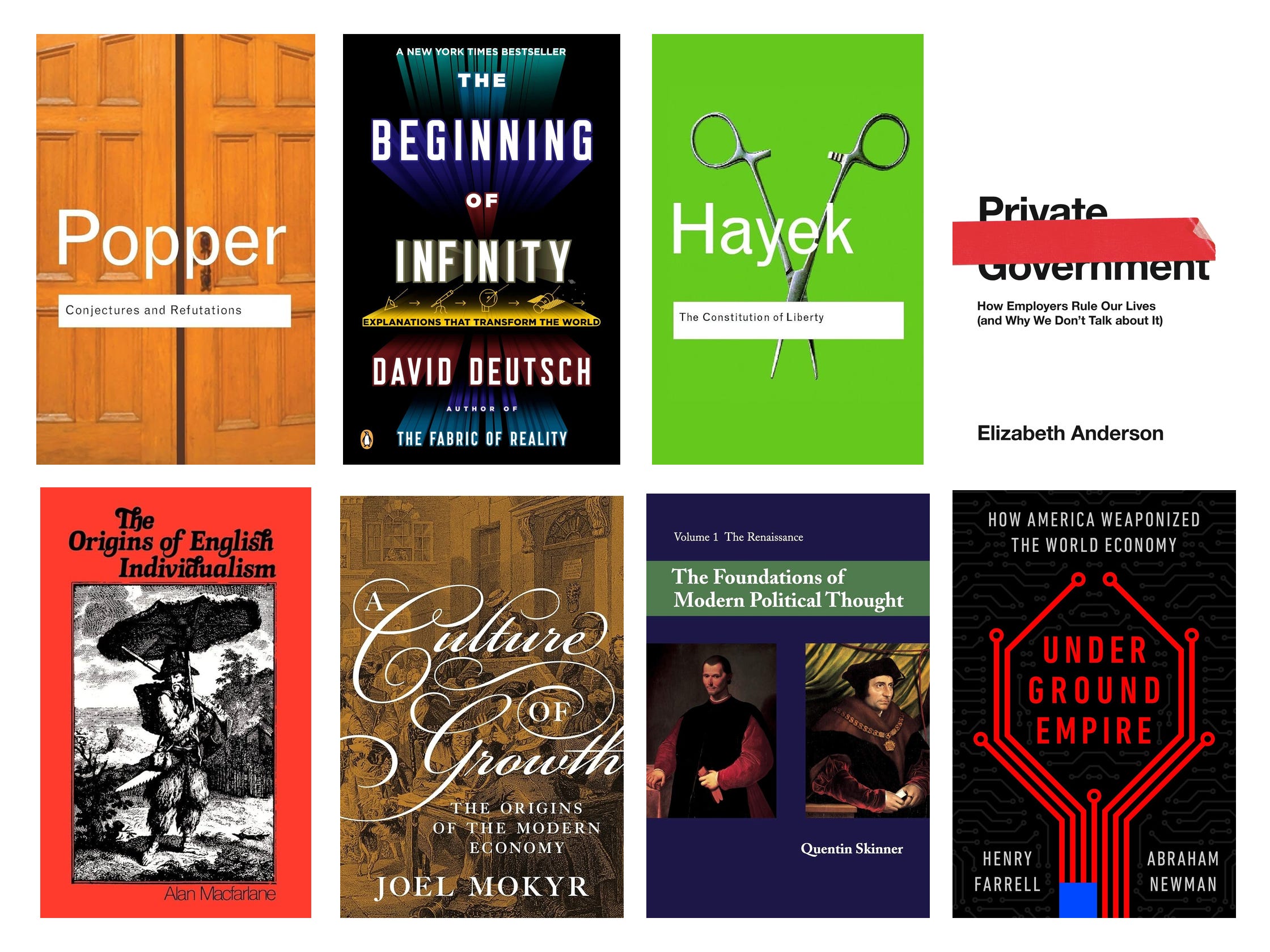
I’m a big believer that the genius of the British constitution is the capacity for error correction, so I’m a big fan of Popper and Deutsch in that vein. Relatedly, I think a lot of my appreciation of the value of permissionlessness and bottom-up action comes from Hayek - but tempered by people like Elizabeth Anderson and their warnings about the risk to freedom from private as well as public power.
I’d say, though, that historians have been at least as important for me intellectually as philosophers: my beliefs about British exceptionalism are strongly influenced by Alan Macfarlane and Joel Mokyr, and Quentin Skinner’s work has left a lasting impression on how I think about ideas and public argument. More recently, Henry Farrell’s work (with Abraham Newman) on weaponised interdependence has shaped my thinking about technological sovereignty (and I also like Farrell’s work with Cosmo Shalizi on “cognitive democracy” - another helpful dialogue with Hayek and markets).
5. What does human flourishing mean to you?
I find it hard to go beyond my answer to question 2, above: human flourishing is about people having the material and social conditions that mean the choices they make about their lives can be both meaningful and effective.
6. What’s one book you’ve read recently that you’d recommend?
Greg Egan’s Permutation City is over 30 years old, but it’s remarkably prescient (and I only just read it). Excellent read if you still need to convince yourself that we’re always going to be short of compute.

7. What’s your most irrational belief?
Some would say part (3) of my answer to the first question! Other than that: at some level, I do believe that I am a very lucky person.
8. What’s the most interesting tab you have open right now?
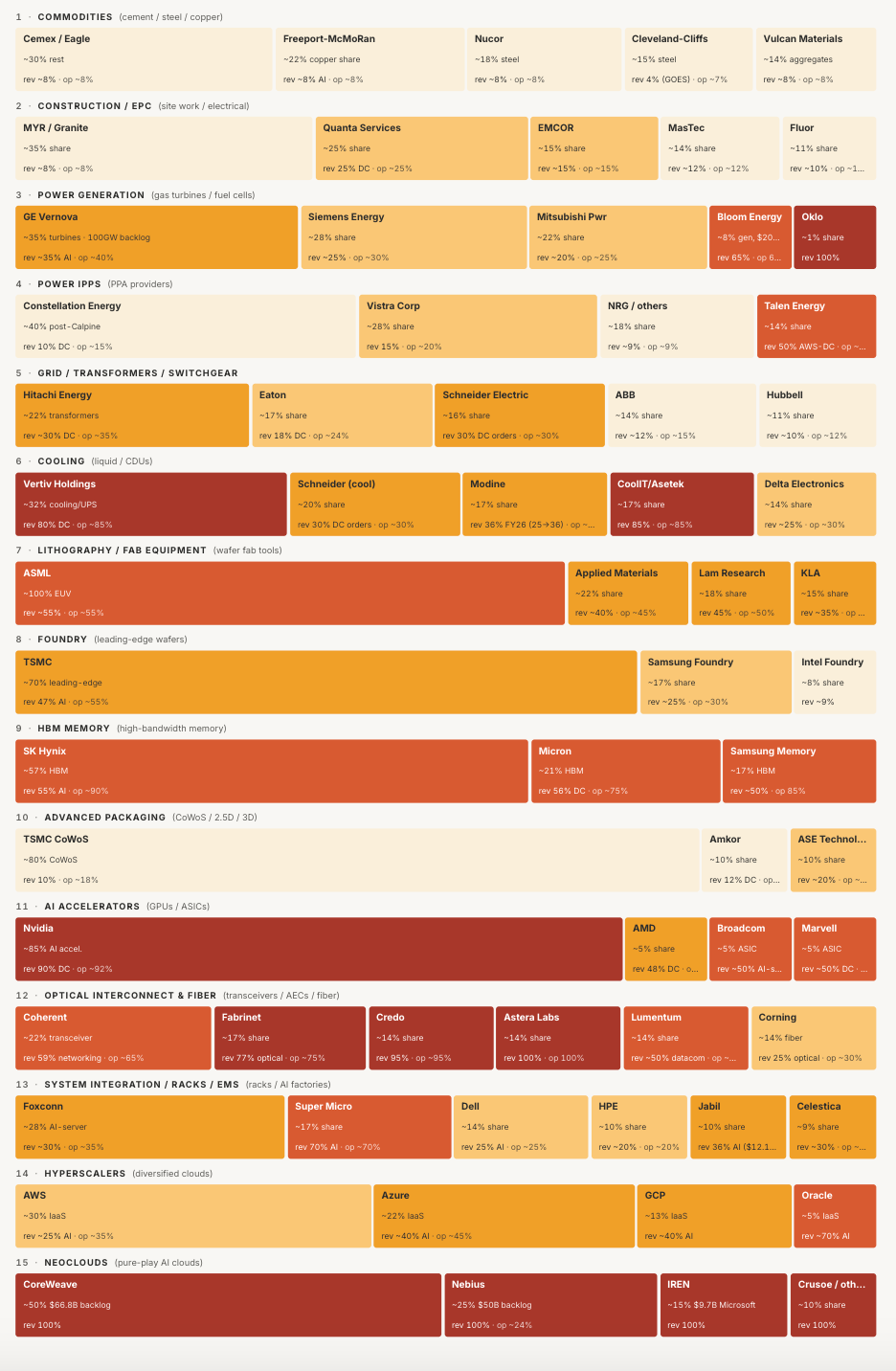
Probably this visualisation of the AI supply chain and who owns it.
9. Who is one writer or thinker today who you think is underrated?
Is Séb Krier still underrated? Maybe so - still under 25,000 followers on X - even though he is now much better known than a year ago. Jack Wiseman’s Inference and Rohit Krishnan’s Strange Loop Canon should each be at least ten times bigger too.
You can read more about Matt’s work on his website and get in touch with him on X.
This is the fourth instalment in this interview series. You can also see our interviews with AI Underwriting Company co-founder Rune Kvist, ex/ante founder Zoe Weinberg, and Zena Hitz, the founder of the Catherine Project.
To nominate someone for “What Will You Build For?” leave a comment below, or send us a DM.
Cosmos Institute is the Academy for Philosopher-Builders, technologists building AI for human flourishing. We run fellowships, fund AI prototypes, and host seminars with institutions like Oxford, Aspen Institute, and Liberty Fund.
One question I keep returning to: as AI becomes more capable, what is the civic infrastructure that sits between raw intelligence and human institutions?
We've spent decades building systems for information and markets, but comparatively little for trust, context, and collective sensemaking. If AI dramatically increases our ability to generate content, decisions, and influence, then the bottleneck may become coordination itself.
With the emergence of AI, I've become more interested in a new public layer above today's platforms that allows communities to add context, provenance, reputation, and governance directly at the interface level rather than relying solely on platform owners or regulators.
It feels adjacent to the questions around cognitive democracy, state capacity, and abundance that you're exploring. Curious whether you see interface-level trust infrastructure as a meaningful part of the AI transition.
You should interview Finn Murphy @ Nebular!