

Archers are more likely to hit a clear target. Aristotle reminds us that the same is true of our life’s work: we will only be able to build with meaning and purpose if we know what we are building for.
This question was on our minds as we gathered 120 thinkers and builders from frontier AI labs, top universities, and cutting-edge institutions for the first Cosmos Symposium. Among them were the creator of Fortnite, category theorists, the principal of Alpha School, researchers from OpenAI and DeepMind, and first-time founders building for human autonomy
But as Brendan said in his opening remarks, no one in the room, or indeed the world, is yet a philosopher-builder.
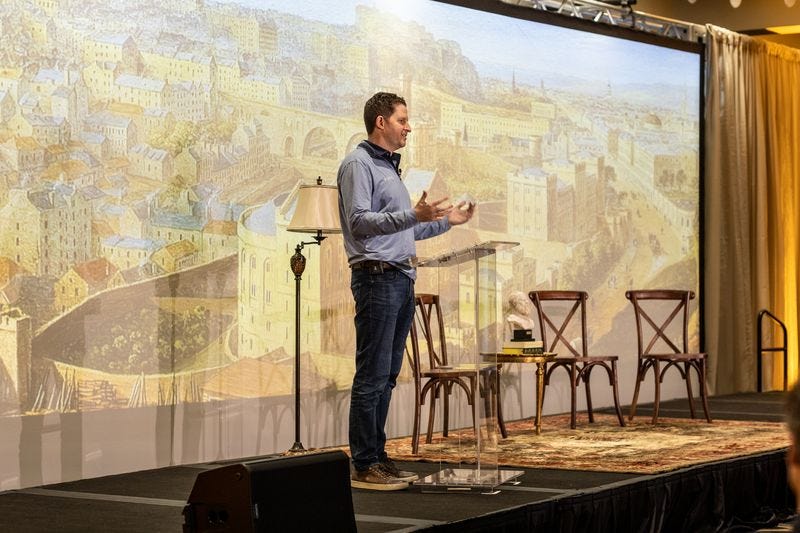
Over the past two and a half millennia, there have only been a handful of true philosophers who pursued fundamental questions with courage and relentlessness. The number of people who have then applied this energy to institution-building that enhances freedom and inquiry for the individual is even smaller; the best example is Benjamin Franklin.
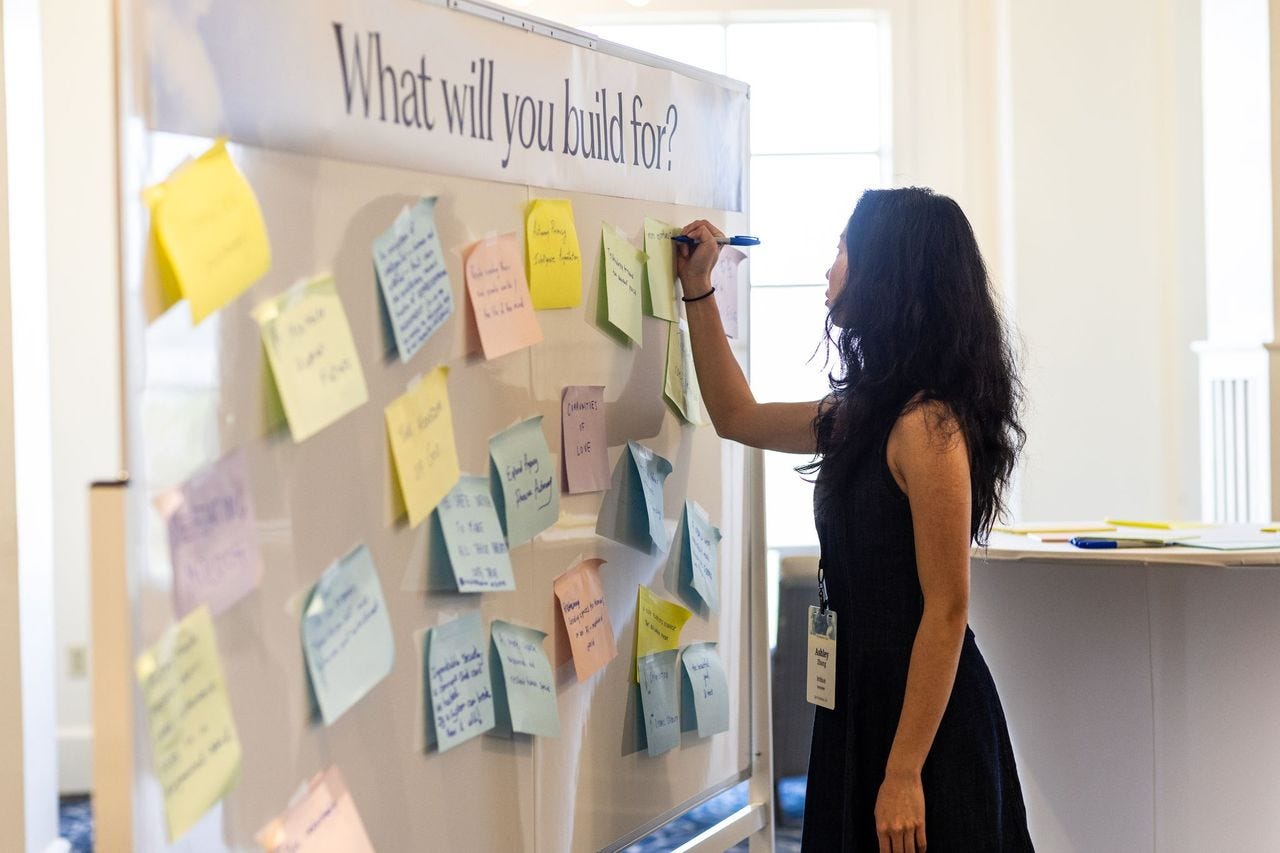
Nevertheless, there was no shortage of ambition. During the event, attendees shared what they were building on a whiteboard. The responses varied significantly, ranging across human goods like strengthened community, augmented intelligence, and a more enriched life of the mind. Underneath this difference in emphasis was a shared belief that we are building towards a greater goal. Everyone in the room saw more capable technology as a means, not an end.
Before the event, everyone nominated a book that shaped their view of the world. Many chose the classics – Plato’s Republic, Smith’s Wealth of Nations – but we also had science fiction, writings from theologian John Henry Newman, and a history of American nuclear power.

To our surprise, one of the most nominated books by attendees was Martin Heidegger’s famously challenging Being and Time. In Being and Time, Heidegger rejected René Descartes’s traditional account of consciousness, which depicts a detached mind peering out at an external world. Instead, Heidegger insisted that we are already caught up in the world, acting on it before we ever step back to think about it. At a time when it can feel like the development of technology is following a fixed path and the best we can do is act as users or spectators, he may have something to teach us.
As only 120 of us could be in the room, we’re sharing a few of our main takeaways from the event.
1. The importance of ‘becoming’
Shortly before Adam Smith died, he ordered that 16 volumes of his manuscripts be burned. He was so anxious that only his best thinking survive that he destroyed the record of his own becoming: the drafts, notes, abandoned arguments we might have learned from
We tried to do the reverse of this at the Symposium by bringing people together at different stages of their journey. This included:
Highly accomplished builders, who are pursuing mission-driven projects and can act as inspiration, such as Joe Liemandt, the principal of Alpha School or Paul Meegan, the creator of Fortnite and founder of a new stealth venture;
Former researchers and engineers at leading tech companies and frontier labs, now building for human goods, like Alex Komoroske, a 15-year Google and Stripe veteran and Ivan Vendrov, a former Anthropic researcher and ex-head of collective intelligence at Midjourney;
First-time founders who are building for human autonomy, such as Workshop Labs co-founder Luke Drago;
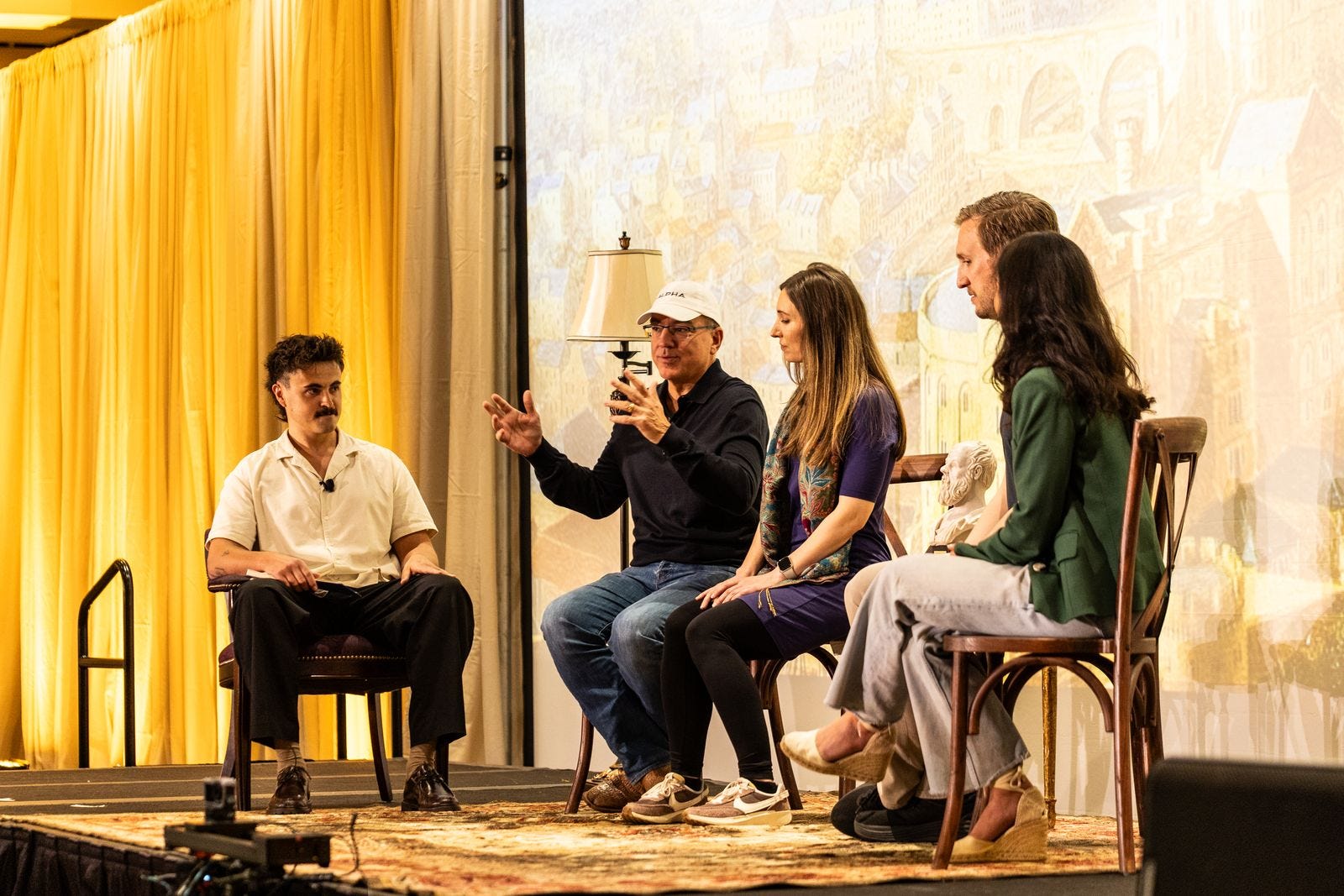
World-class intellectuals who are helping to lay the crucial foundations for future builders and thinkers, such as Philipp Koralus at the Oxford HAI Lab, Rebecca Lowe at the Mercatus Center, UT Austin’s Harvey Lederman, Catherine Project founder Zena Hitz, or Seth Lazar, founder of the Machine Intelligence and Normative Theory Lab.
All of these groups had something to learn from each other, whether it was hard-won knowledge about what it actually takes to ship something, fresh insights from the frontier of AI research, or clarity about what’s worth building and why.
2. Building the philosophy to code pipeline
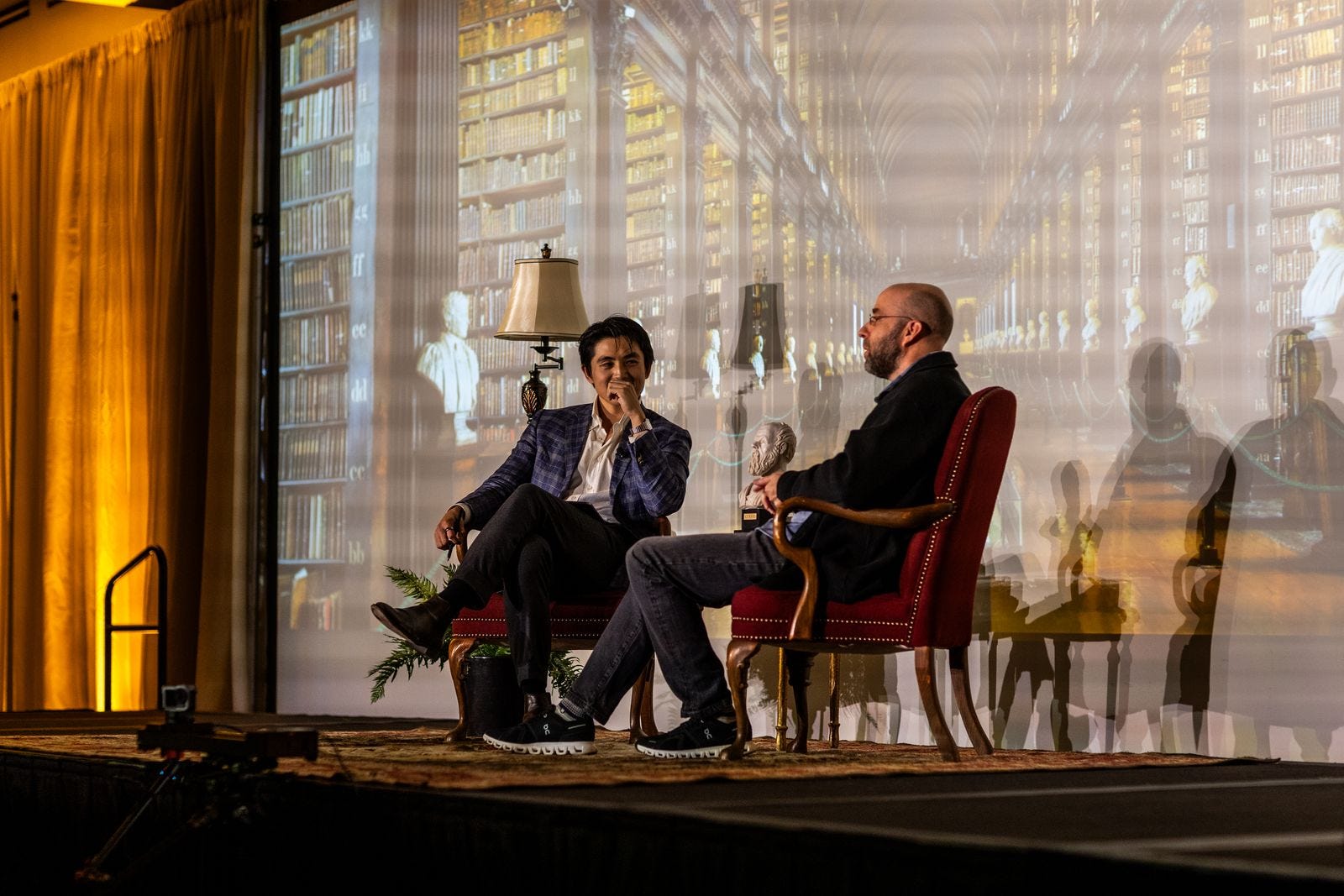
Philosophy can feel remote from the realities of shipping a product. It can be easy to default to obvious ideas, like introducing greater personalization through a system prompt. Attendees explored options that show why steerability is essential but insufficient.
These included tools that surface the assumptions a model makes about us, and ways of aligning models with our second order preferences: not just what we want, but what we want to want.
Some of these projects are still in their early stages, so we can’t share too much detail at the moment, but we were grateful to be joined by members of the Cosmos community who are entering institution-building mode. These included Samuele Marro of the Institute of Decentralized AI, Elian McCarron of Kanonic, and Jasmine Li, who is starting an organization focused on measuring and forecasting human agency as AI capabilities advance.


3. Epistemic humility
As one of our speakers observed, autonomy requires humility. The philosopher-builder will need to constantly ask whether they are doing the right thing and course-correct when the answer is no.
Elsie Jang from the Mercatus Center recently wrote an essay on how the same evidence in frontier AI debates can justify sharply conflicting hypotheses. Despite all of this talent in one room, none of us left Austin feeling certain.
The discussions raised vital questions that lack a definite answers:
How can we build for second order preferences without defaulting to paternalism?
How can we prioritize human autonomy, while using capital markets to reach hundreds of millions of people?
What are the limits of decentralization? What high-level coordination or condition-setting is needed to create useful, coherent action in the real world?
Some debates, especially around frontier AI, can feel tribal, which is why it’s important for communities to build strong norms. At the symposium, we saw people treat conversations as conversations. Each interaction felt like an opportunity for two people to learn, and we received no reports of distillation attacks.


4. Structure and spontaneity
Nietzsche thought Greek cultural greatness stemmed from the fusion of the Apollonian and the Dionysian. Apollo, the god of light, represented clarity, structure, and rational boundary-making. Meanwhile, Dionysus, the god of wine-making, represented the dissolution of those boundaries.
In our own modest way, we attempted to replicate this formula. Alongside our structured programming, attendees had time to mingle over drinks, dinner, and across the sprawling, beautiful grounds of the venue. The best conversations were often the spontaneous ones, still running late on Sunday morning, long after the formal programming ended.


This was the first Cosmos Symposium, but it won’t be the last. The Cosmos community is just over a year old and we’re grateful to everyone who has contributed to what we’re building.
If you’re interested in attending a future Cosmos event, register your interest on our seminars and events form.
Cosmos Institute is the Academy for Philosopher-Builders, technologists building AI for human flourishing. We run fellowships, fund prototypes, and host seminars with institutions like Oxford, Aspen Institute, and Liberty Fund.
If you’re someone who thinks deeply, builds deliberately, and cares about the future AI is shaping—join the Cosmos network.
I count 5 copies of Being and Time...
Serious question though, how do we design for philosophical principles while also turning a profit? I've worked in Silicon Valley and startups over a decade, and my experience is that almost no one with money gives a hoot about any of this.
It's extremely difficult, if not impossible, to get any sort of financial support as a solo builder unless you're well-connected or can demonstrate market success. In my experience, there is zero grace for a more holistic approach that builds from first principles unless perhaps you have a pedigree or a letter of introduction, metaphorically speaking.
Founders' philosophical justifications tend to be post facto and ad hoc; only survivors are permitted to pontificate, usually in the form of subtle marketing posing as podcast interviews or Substack posts. The inner machinery and pressures of a startup founder is usually 10x more chaotic than the ordered and considered air of a philosophical symposium, as I'm sure many of your attendees know from first-hand experience. How can they realistically incorporate these noble aims into an enterprise in a non-superficial way?
Maybe the answer is lots of institutional support. I've been trying to build startups on my own with no support for over ten years, I never had the luxury of an organization or team backing me. On the one hand, I'm jealous. On the other hand, I wonder what happens when philosophical rigor meets market rigor. You can understand how efforts like these could be seen cynically as a form of self-delusion that can only be maintained within an insulated environment, whether that's a mega-corporation or an academic institution.
Do you guys believe that solo philosophical-builders can make it? Or is it the idea to train engineers who will advocate for change from within larger orgs? I fear what will happen if people like me are run over by big labs and big capital. The world needs rogues. AI can potentially empower us, but if the only way to engage with building AI itself philosophically is to subordinate our efforts to those of large corporations, then the solo philosophical-builder is doomed.
I hope my comments aren't interpreted as an attack; far from it. I wish I had found you guys earlier. I believe in what you're doing, I'm just genuinely curious as someone who has struggled in the trenches for years with the exact same questions what the game plan is for implementation. The industry can be brutal.