

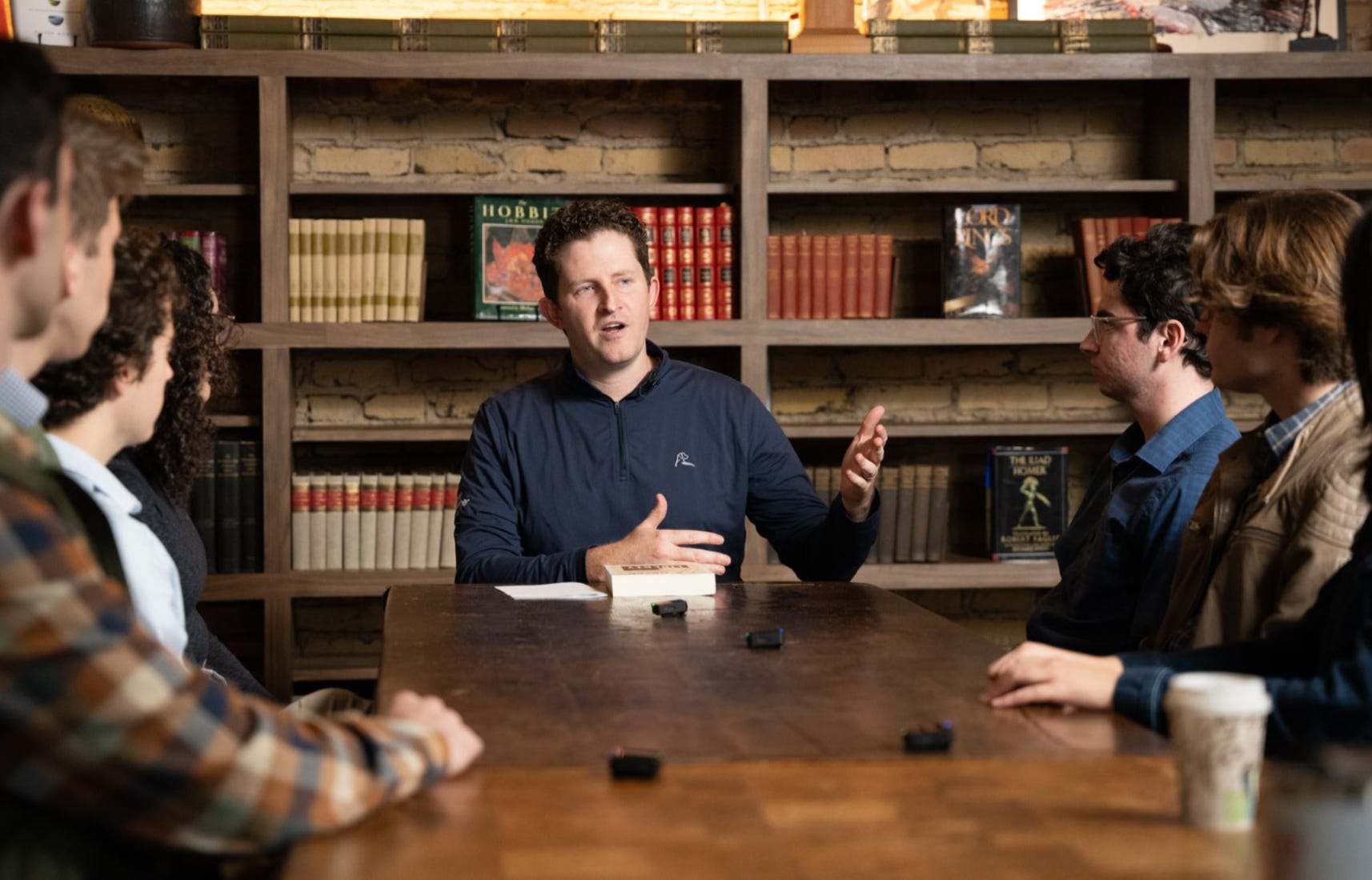
Thank you for all your responses – you can now see the responses to the AMA here.
This week, we crossed 20,000 subscribers on Substack. Thank you to everyone who has read, shared, and engaged with our work.
We’ve written about Claude Boys to Coasean bargaining to the perils of liberal nudging. Reading the comments has often been as rewarding as writing the posts. To mark the milestone, I’ll be answering your questions on Wednesday April 15.
Drop your question in the comments below and upvote the ones you want answered. I’ll start responding next week and I’ll try to take as many as I can.
There are a few things I’ve been thinking about that we haven’t written about yet. This seems like the right place to start.
Ask about Cosmos, human autonomy, AI x philosophy, or what people in our network are building. Especially questions that are hard, that relate to how we approach AI as builders, or that challenge our assumptions.
- Brendan
Hi Brendan, congrats on 20k and thanks for taking questions!
You argue that philosopher-builders need explicit moral commitments to avoid optimizing for the wrong things. But your three pillars (truth-seeking, autonomy, decentralization) are themselves a normative framework that not everyone shares. China's AI strategy is still coherent, explicit, and philosophical, it just starts from different premises. So how do you argue for your philosophy without just replacing one set of defaults with another? What makes Cosmos's values the right foundation rather than just a well-packaged preference?
Excited to hear your thoughts!
Assuming frontier large language models, together with their multimodal and agentic extensions, are trained to effective saturation on an exhaustive corpus that represents the totality of digitized human knowledge including all scientific publications, books, patents, archival records, cultural artifacts, and recorded conversations, will these systems be capable of transcending the statistical manifold of their training distribution to autonomously discover, validate, and iteratively expand novel knowledge beyond the current human frontier?
More precisely, through architectures enabling iterative self-refinement, tool-augmented agentic workflows, formal verification frameworks (e.g., Lean theorem provers or physics/chemistry simulators), multi-agent scientific collaboration, and scalable inference-time compute (e.g., test-time reasoning chains or reinforcement learning from verifiable rewards), can such systems generate original hypotheses, mathematical proofs, experimental designs, or empirical insights that were previously unknown to humanity? Or, conversely, will inherent architectural and data constraints such as interpolation within the training distribution, model collapse under recursive synthetic data, solver cause capabilities to plateau at or near the limits of extant human knowledge?