

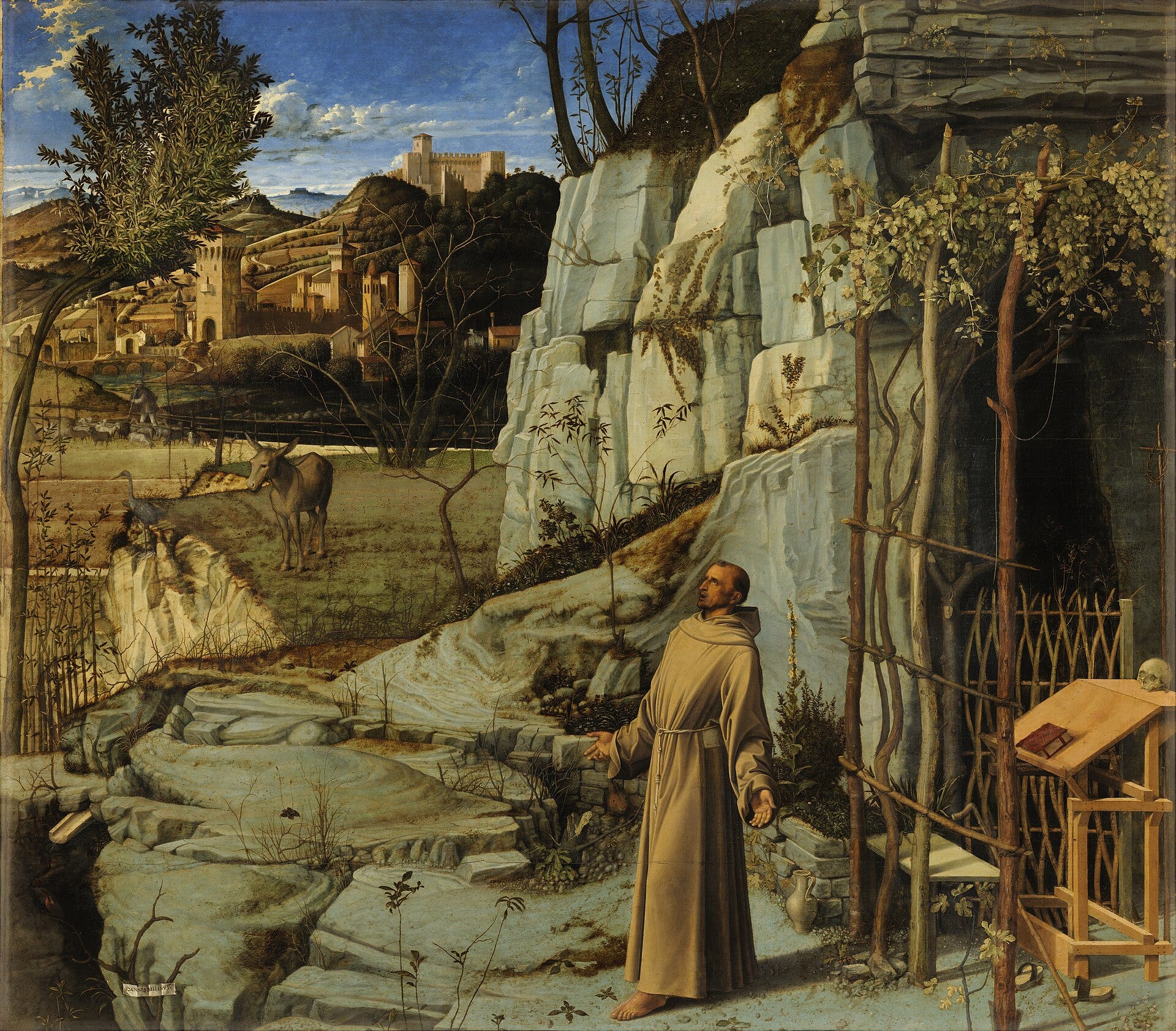
The fourth-century Greek ascetic Evagrius Ponticus described how monks would be beset by a “noonday demon” between the hours of 10 a.m. and 2 p.m. This demon would make the monk feel the drudgery of his work so intensely it was as though the sun had slowed down. The monk would “hate the place and his way of life and his manual work” and “desire other places where he can easily find all that he needs and practice an easier, more convenient craft.”
This demon was called acedia, which derives from the Greek term for a “lack of care.” These days acedia is more commonly rendered as “sloth,” with its connotations, but the ancients and subsequent scholastic writers conceived of it more richly.
Saint Thomas Aquinas saw acedia as a sadness or disgust that weighs down the mind, until it wants to do nothing, with important spiritual duties feeling burdensome. As “no man can be a long time in company with what is painful,” it drives the monk to indulge in curiosity, idle talk, and to seek out distraction. Eventually, it can cause the sufferer to detest spiritual goods.
The monks were describing an aversion to God that needed to be warded off through obedience and perseverance. A similar modern acedia, however, could apply to any good that can only be reached through slow, determined work. Cheap intelligence poses a challenge to our longstanding model of formation, in which judgment is acquired through perseverance and apprenticeship. AI can increasingly offer people an approximation of the fruits of determined work, without them having to endure the hard work.
A common response from the optimists is to argue that AI will help us to automate the “bad work” (drudgery), while we can proactively choose to keep “the good work” (valuable formation). Microsoft CEO Satya Nadella has argued that AI will “remove the drudgery of work and unleash creativity,” while government and corporate guidance routinely distinguishes between routine work that can be autocmated and tasks that involve higher-order judgment that people should retain.
But what if this distinction is harder to identify than we think?
Keep on drudging
Over the course of history, machines have relieved people of enormous quantities of backbreaking, miserable work. But the burdens technology has unshackled us from rarely consisted of pure, unalloyed drudgery. This work is often the means through which we acquire skills, habits, and attachments.
The philosopher Albert Borgmann described the “device paradigm.” This is when a technological device is able to separate a desired good from the machinery we use to procure it. This commoditizes the good by making it instantaneous, safe, and easy to obtain.
He used the example of the family stove being replaced by central heating. Superficially, this was one means of heating a home being swapped out for a more convenient one. But the old stove also “provided for the entire family a regular and bodily engagement with the rhythm of the seasons that was woven together of the threat of the cold and the solace of warmth, the smell of the wood smoke, the exertion of sawing and carrying, the teaching of skills, and the fidelity to daily tasks.”
Borgmann is not arguing that chopping wood happens to have some positive educational externalities. Instead, his point is that to manage the stove competently, people had to pay attention and learn how to respond to the world around them – it required “intensive and refined world engagement.” Central heating, by contrast, “procures mere warmth” while reducing the demands previously made on our skill, strength, and attention.
Similarly, you can enjoy music by gathering a group of friends with instruments or you can switch on a stereo. The stereo system allows you to listen to a huge variety of genres, played by the most talented musicians, at any time. Musical practice demands “regular and skillful engagement of body and mind” and embodies traditions of craft, method, and composition. It challenges the player to develop capacities in response to them.
Despite his nostalgic tone, Borgmann is not exhorting us to tear out our boilers or smash up our stereos. Sometimes the loss of certain skills in exchange for convenience or access is a good trade. If I want to hear a beautiful performance of a Mozart string quartet, I am glad that I do not have to teach myself the violin to virtuoso standard and conscript three of my friends. Instead, he is arguing that technological disburdenment can remove forms of engagement as well as drudgery.
Learning your scales might be boring, but it teaches you about the fundamentals of musical composition and the capabilities of an instrument. This produces a relationship with an instrument and music that cannot be reduced to the acquisition of a technical skill. The effort is not an inefficient means of obtaining an independently available good, but part of the way the activity acquires meaning in our lives.
Skill and practice
It’s also hard for an outsider to recognize the goods of a particular practice. In After Virtue, Alasdair MacIntyre gives the example of trying to teach an intelligent child how to play chess.
At first, they will only play chess if they are paid in candy, with the promise of more candy if they win. Under these circumstances, it is completely rational for them to cheat. But MacIntyre imagines that through playing the game, they may learn that there are goods internal to chess, such as analytical skill, strategic imagination, and competitive intensity. The child would no longer want to cheat, because they would be denying themselves these goods.
MacIntyre argues that these internal goods can only be identified through participation in the practice. That makes it harder to inspect the burdens of a practice from the outside and decide confidently which are dispensable. This is because a practice is “never just a set of technical skills,” even when those skills are mobilized toward a unified purpose.
What distinguishes a practice is partly that participation changes the practitioner’s conception of the ends their skills are serving. A technical skill might be replaceable as a means of achieving an output, but still play a role in initiating someone into a larger practice. On one level, the internal good of painting is producing good paintings after (hopefully) obtaining the ability to do so through some combination of discipline, perseverance, and talent.
But another lies in living the life of a painter. To enter into a practice is “to accept the authority of those standards and the inadequacy of my own performance as judged by them. It is to subject my own attitudes, choices, preferences and tastes to the standards which currently and partially define the practice.” While those standards can be criticized, intelligent criticism comes from within a tradition of achievement, rather than from a novice believing that their present preferences are somehow authoritative.
Potemkin Institutions
Highly capable AI systems have much more radical implications than any of Borgmann’s devices. When someone owns a stereo instead of being able to play an instrument, people are unlikely to mistake them for a talented musician. When I step into a warm house, I don’t thank the host for tending to the hearth.
Historically, if a student produced a good essay, it was possible to at least infer something about their ability. The link between output and ability, while not completely severed, is weakening. As models improve, it is likely that it will weaken further. This is a problem when institutions use these outputs to allocate external goods, such as grades, qualifications, money, and professional status.
The real issue here is not that it will become easy to cheat. It’s that many institutions will actively embrace the shortcut. To most firms, time saved and increased output are legible, good outcomes. The hypothetical lost skill and judgment are often not visible until it is already too late.
A junior lawyer who is tasked with digging up relevant cases for an opinion is exercising a technical skill, rather than the practice of law. If searching for these cases is simply an inefficient way of locating an authority, then it could be automated with little consequence. But if repeatedly searching is a way of learning how different legal doctrines fit together and what a good legal argument looks like, its automation may well preserve the output while eroding the junior lawyer’s understanding of the practice of law. As the mathematician Terence Tao has argued: “AI tools are like taking a helicopter to drop you off at the site. You miss all the benefits of the journey itself. You just get right to the destination, which actually was only just a part of the value of solving these problems.”
A lazy student or apprentice historically might have conceded that a standard is real, but that they were failing to meet it. When a machine can conveniently reach the standard for you, it can intensify acedia. When Evagrius’s monk is afflicted by the noonday demon, he does not simply lose the desire to work, but comes to hate his way of life.
Our junior lawyer is now toiling away knowing that there’s a cheap piece of SaaS that could produce the relevant authorities in a matter of seconds. The more completely a machine can produce the visible outputs of a practice, the more irritating and hateful the standards that require real effort on the part of the practitioner. If their senior colleague tells them their resulting argument is formally defensible, but nevertheless bad, why should they take their opinion seriously if an AI tool doesn’t detect a difference? What if “judgment” and “craft” are the arbitrary preferences of an elite keen to preserve its status?
John Cassian, another fourth-century ascetic, described how acedia would lead the monk to engage in dishonest rationalizations about why he needed to leave. Maybe he ought to visit the sick or attend to a neglected religious woman. This would be a better use of his time than “staying uselessly and with no profit in his cell.” He might even selectively pick verses from Scripture to justify excluding himself from manual work. Similarly, Evagrius’s monk tells himself that he can leave his cell, because God can be worshipped anywhere.
On one level our junior lawyer does have a point – Tao’s helicopter has its advantages. By speeding a journey along, you might visit ten places in the time you would have spent visiting one. We can test more arguments, explore more hypotheses, or attempt more projects. In many cases, it may even lead to better outcomes.
But this radical increase in agency might come at the cost of understanding. This is a difficult thing to acquire and it’s easy to fool yourself into thinking you have it. The difficulty arises when there is no independent test of whether the result is good. One AI system can critique the output of another, but both are drawing on the similar sets of inherited patterns and assumptions. Understanding is what lets practitioners judge plausible answers, their underlying assumptions, or when a new approach is needed. This is why the separation between practice and outcome is inherently unstable. You may be able to fool most of the people most of the time, but eventually, the edge cases will catch up with you.
Of course, we may not even notice this pattern for a long time. As MacIntyre concedes, “institutions and technical skills serving unified purposes might well continue to flourish.” Money, status, promotions, or qualifications may continue to slosh around. But once institutions lose the ability to judge error, distinguish excellence from imitation, train successors, or push a practice beyond its existing standards, then we risk being stuck with the simulacrum. Institutions can live on inherited standards and machine-assisted outputs for a long time, while spending down the human capital required to preserve and renew standards.
Living under the yoke
John Cassian wrote about Abbot Paul, a figure who managed to overcome acedia. He lived in a cave, a seven days’ journey from the nearest town, with enough dates and produce to support himself. He gathered palm leaves and fashioned them into baskets, but never sold them. At the end of the year, he would burn all his palms.
He did not work for any kind of external good, caring only for “purifying his heart, and strengthening his thoughts, and persisting in his cell,” and above all for “gaining a victory over acedia and driving it away.”
Unfortunately, most of us lack the mental fortitude of Abbot Paul. As we know from the triumph of first television and then short-form video over the book, it is hard to resist the path of least resistance. We don’t have to be intellectually persuaded that TikTok is better for us than sustained reading; it need only be easier in the moments our concentration falters. AI brings that asymmetry to writing, research, study, coding, and much else.
There will never be an indisputable taxonomy of formative and nonformative work, which means we should approach how we change work with profound humility. Sometimes there will be no point doing things the hard way. But if a task was historically part of a route that formed competent practitioners, we should be cautious about removing it until we have a good reason to believe that the same capabilities can be acquired some other way.
The alternative is not to embrace a life of pointless toil. We should remember the instructions on the daily labor of monks in the Rule of Saint Benedict, which advises that “all things should be done with moderation… for the sake of the faint-hearted.”
Human life and our character is shaped by our encounter with the world. This includes the difficulties and struggles we choose to embrace, as well as the ones we face through fortune or inheritance. For Evagrius, the opposite of acedia was hypomonē, which literally means “remaining under” or steadfastness. This may not be easy, but it’s preferable to a textureless life of want-satisfaction, all watched over by machines of loving grace.
Cosmos Institute is the Academy for Philosopher-Builders, technologists building AI for human flourishing. We run fellowships, fund fast prototypes, and host seminars with institutions like Oxford, Aspen Institute, and Liberty Fund.