

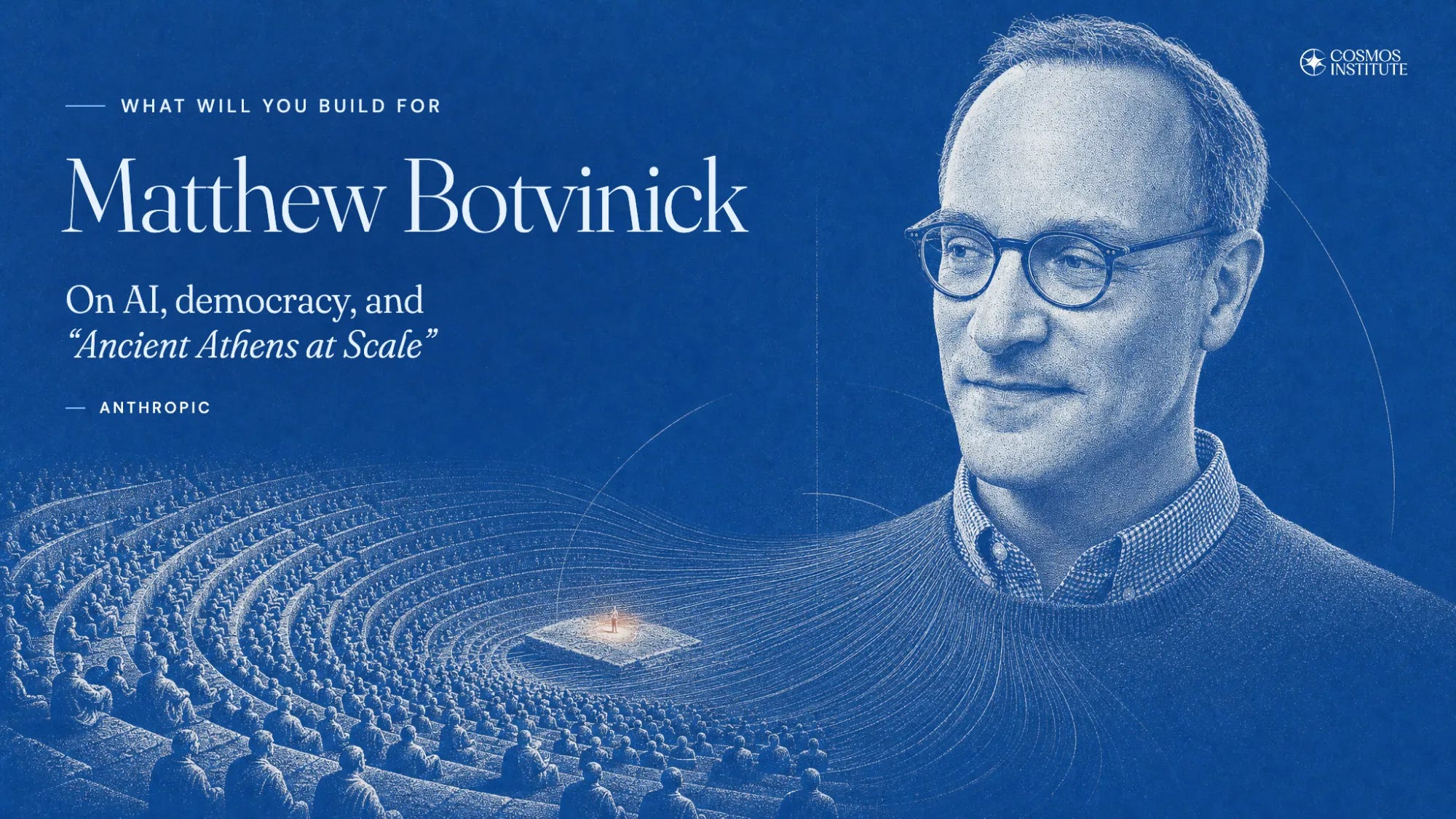
Every builder’s first duty is philosophical: to decide what they should build for. This series interviews founders and institution-builders who are building towards their vision of the human good.
We spoke to Matthew Botvinick, a senior fellow at Yale Law School, and a Senior Research Fellow at Cosmos Institute. He has held multiple research positions in the AI industry, including at Google DeepMind and currently Anthropic, where he leads the company’s work on AI and the rule of law.
He is also the author of AI and Political Freedom, a new book exploring the challenge AI poses to democratic institutions and how we should respond.
He writes in a personal capacity.
What does AI change about democracy that earlier technologies did not?
AI doesn’t qualitatively change anything about democracy. Its effects are quantitative. AI takes existing opportunities and vulnerabilities and amplifies them. The opportunities are the same as ever, but can now be pursued with much greater efficiency and effectiveness. And the vulnerabilities are the same ones that have dogged democracy since its invention, but are now much more serious. My book is primarily (though not exclusively) about the vulnerabilities. I try to make the case that AI raises both the risks and the stakes. By risks, I mean that AI will put new pressure on the places where democracy has always been vulnerable, making it more likely that democracies will falter. By stakes, I mean that once democratic backsliding begins, AI will make it much harder to reverse.
To make the case briefly, the risks center on AI’s relationship with the authoritarian playbook, the standard set of strategies that leaders use to deconstruct democracies. The leading-edge risk comes from AI’s effects on labor. Historically, when people have come to feel insecure economically or in terms of their social status, they become vulnerable to populist appeals, appeals that often open the door to authoritarianism.
If this occurs – and I think arguably it has already begun – then two other threats become relevant. The first is that AI will give rise to national security crises, crises that will provide an excuse to invoke states of emergency that dangerously expand executive power. Second, the integration of AI into government intelligence work will provide the infrastructure for domestic political surveillance. Again, I think arguably both of those processes have already begun.
What do you see as the 21st century’s greatest authoritarian risks?
I worry about the spread of the Chinese toolkit for political surveillance and control. China has been exporting this energetically – an excellent New York Times piece recently detailed how this is playing out, for example, in Uganda. At present, this primarily means that China is furnishing tools for digital authoritarianism to countries that are already ruled by dictators. Even there, the technology can have an impact, because it helps such leaders entrench their power in a way that was previously impossible. What I worry about still more is that current democracies, during some paroxysm of populist authoritarianism, will embrace the Chinese model, and perhaps even Chinese tools. Viktor Orbán was working on this when he was ousted, for example. I worry that the same strategy may be adopted at some point in France, or Germany, or the U.S.
In the much longer run, I think we face a different set of concerns. I know it is controversial, but I belong to a camp that believes AI will eventually bring about the end of work. When this happens, I worry about political accountability. Democracies usually rely on broad-based taxes on labor, and this is one factor that keeps government accountable to citizens. Where that dependency is lacking – as for example in present-day petrostates – democracy rarely prevails. This is the “political resource curse,” and I think we should be concerned that it will arise in a future where AI eliminates most jobs. Protecting democracy against that future hazard will, I think, require us to remodel our institutions rather profoundly.
You describe “Ancient Athens at Scale.” What does the Athenian comparison help us understand about AI’s democratic potential?
The fascinating thing about ancient Athens is that there simply was no distinction there between those who ruled and those who were subject to their rule. To be clear, I’m thinking here of the demos, the citizens of Athens, and setting aside (with a guilty conscience) Athens’ population of enslaved humans. The point is that the Athenian assembly, made up of a rotating set of randomly selected citizens, simply was the government of the city-state. As Aristotle put it, their “principle of unity” was “for all to rule and be ruled in turn.” This setup is particularly interesting in view of modern analyses of political freedom. As Daron Acemoglu and James Robinson have argued, open societies depend on a balance of power and capacity between the state, on one side, and society on the other. As I suggested earlier, this balance may be very difficult to sustain in a future where AI imposes the political resource curse. So one way out of the trap is to aim ourselves back to something that looks like ancient Athens, where we blur the line between state and society, bringing ordinary citizens into a more direct, hands-on role in government.
The ingredients for this are already available, and encouragingly they also point to a way out of the broken political culture I was lamenting earlier. Deliberative democracy gives us tools and methods to bring citizens together for productive deliberation, and governments are increasingly experimenting with how to build deliberative democracy – citizens assemblies, deliberative polls, and other similar models – into their institutions.
The one ingredient that has been lacking is a way to scale such processes up, so that they can have democratic legitimacy in polities on the scale of modern nations. What I argue in the book is that AI itself might offer a solution to that scaling problem. And in fact, organizations like the Stanford Deliberative Democracy Lab are already using AI to stage deliberative assemblies involving thousands of people. So this is starting to take shape.
How do you draw a line between helping someone articulate their political views and forming those views for them?
If we are talking about the mediating role of AI, the answer will depend on whether we’re talking about AI furnishing information to human political reasoners, or whether we’re talking about AI writing text with political content on behalf of human users. Both cases are daunting, but for different reasons. In the latter scenario – imagine someone using AI to write a letter to their representative in Congress – there is, on the one hand, the attractive possibility that AI might enable some people to express their political views, who might otherwise feel too inarticulate or otherwise abashed.
On the other hand, of course, how can we be sure that the AI writer is faithfully representing the user’s political views? And by saving the human writer the work of writing, is the technology also withdrawing the user’s opportunity to develop those views through the process of writing? I have no idea what the right answers are to these questions, but they are questions we’re not going to be able to avoid. And like many other questions raised by AI, it feels to me that the answers should in some way be chosen ‘democratically,’ whatever that means in this case.
If, alternatively, we are talking about AI systems providing information, then we hit another set of profound questions about what role AI will turn out to play in the political marketplace of ideas. That marketplace has, until now, been populated by participants each of whom is a member of the political community, with a clear stake and clear interests. AI breaks this, at least insofar as we see AI as a speaker that is not directly controlled by its builders. The closest analogy – which is not particularly good – is to newspapers or TV news broadcasts, where we have a notion that something like political neutrality or evenhandedness should be the goal. I think there is a deeper value behind this, which is to preserve or maximize people’s political autonomy. Perhaps we can factor that into our goals for AI alignment, going forward. Respecting and enhancing human autonomy seems like a worthy objective, although undoubtedly extremely difficult to operationalize and assure.
As we approach such challenges, it’s important to keep in mind that the baseline we are working from is not perfect. The current political system and the current political marketplace of ideas do not, in my personal view, come anywhere near maximizing citizens’ cognitive and political autonomy. As Joseph Schumpeter suggested – I spend probably too much space in my book quoting Schumpeter -- political parties have turned politics into a branch of marketing. It’s not a formula designed to maximize peoples’ ability to form their own political views with maximal cognitive and informational autonomy. Even small improvements over this status quo could be transformative.
Which widely accepted view in the AI community do you think is mistaken?
I don’t know if anyone would cop to this, but what I sense in the AI community is a faith that we can make things go well if we can only get AI alignment and AI regulation right. AI alignment and regulation are indispensable, of course, but to me they seem woefully insufficient for things to go well. We have to organize society, and in particular our political life as a whole, around this new technology in a way that will allow us to preserve what matters in our social lives. The future of freedom and justice cannot be guaranteed through AI alignment and regulation alone.
It sometimes worries me that the books I hear people in the AI community refer to are almost always science fiction novels. Lest I offend anyone, I have nothing against science fiction. However, I sometimes wish I heard history brought up more. There’s a lot to learn from the history of technology, the history of corporate power, and the history of politics. I’d love it if someone at work mentioned to me not how AI operates in the Culture series or in Blindsight, but how the radio was used differently by Hitler and FDR, or how the broadcasting industry became consolidated over time, or what happened in China when the power of the tech industry threatened to rival the power of the CCP.
Which philosophers have most influenced your work?
When I was working mainly in neuroscience, I learned a lot from Maurice Merleau-Ponty. During my pivot to law and policy, though, I’ve been inspired by a number of writers who aren’t philosophers in the academic sense, but whose work has deep philosophical resonance. I’m thinking here, for example, of Elinor Ostrom or Amartya Sen. Having said that, there is one self-identified philosopher who has had a big impact on my thinking: Philip Pettit. His idea that republican government stems from the core value of non-domination really resonates with me. These days, I try to take non-domination as a sort of North Star, including when thinking about what AI alignment should look like.
Who is an underappreciated thinker on AI and political freedom?
Well, these aren’t writers who have directly discussed AI, but I do wish people thinking about the societal impacts of AI would all read writers like Steve Levitsky and Daniel Ziblatt (who co-wrote How Democracies Die), or Aziz Huq and Tom Ginsburg (How to Save a Constitutional Democracy). The people who I talk with in the AI world are often just as worried as I am about the future of democracy, but they don’t tend to dig into the issue in their reading, from what I can tell. I think people building AI should learn as much as they can about how democracy and the rule of law work, and how they can fail. Those questions are, for better or for worse, extremely relevant to how we build and deploy AI.
Where could AI most usefully improve people’s everyday experience of democratic government?
Honestly, I think the most impactful thing would be to use AI to improve everyday government services – getting a driver’s license, a passport or a parking permit, interacting with tax authorities, applying for welfare, etc. Democratic culture and democratic resilience depend crucially on people’s basic level of confidence that democratic government can help solve problems. If people can see that the trains are running on time, this will be a huge help in bolstering that kind of confidence. I’ve argued for much more exotic ways of using AI to enhance democracy – “Athens at scale” – but I think we can start simple and just see if AI can help get those trains running. That would be a huge shot in the arm for democracy today.
If a government could immediately enact one reform from your book, which should it choose?
In the U.S., let’s pass the Government Surveillance Reform Act. That would permanently end ‘backdoor’ searches of foreign intelligence collections by the FBI, close the data-broker loophole that gives intelligence agencies access to all of our cellphone locations, and impose greater oversight on our secret surveillance courts.
More broadly, I’m hoping that the current political moment in the U.S. will lead us to the equivalent of a post-Watergate moment, where public confidence in government has cratered to such a low level that elected officials feel they have to enact a broad slate of reforms, in order to regain public trust. Just like after Watergate, we need reforms to surveillance law, to the laws governing states of emergency, and to other laws that limit executive power. This includes changes to the Insurrection Act, IEEPA, and other laws we’ve heard about in the news recently.
Going forward, we are also going to have to set things up so that traditional checks and balances continue to operate, as AI gets integrated into government operations. This means making sure we define ‘federal record’ to include prompts and outputs of AI systems, that we establish statutory requirements to govern AI procurement, and that we equip Congress and the courts to keep up with the executive branch, since AI is likely to accelerate executive operations more than the operations of the other branches. Congress will probably need to build out some form of digital oversight capacity, for this to work long-term.
Are there historical analogues that are instructive for thinking about how we maintain freedom as AI capabilities advance?
One parallel that I find interesting is the one between data centers and railroads. In the late nineteenth century, populist anger was focused on railroads, as the symbols of how a plutocratic elite were hijacking government and imposing unfair economic conditions on local businesses, especially farms. What grew out of this (and other forces) was the Progressive movement, which in the end produced new forms of regulation and administrative bureaucracy. The same kind of populist anger is now coalescing around data centers.
The new populist moment was captured vividly in a recent D.C. meeting where Steve Bannon and Bernie Sanders gave back-to-back presentations, both sounding the same populist note. The question is whether this new populism will, like the Progressive movement, lead to reforms that serve the public interest, or whether – as is more typical with populism – it will instead feed authoritarianism. The deciding variable might be public confidence in democratic institutions. If people have faith that democracy is capable of acting effectively to address the sources of anxiety that data centers represent, then there is hope for our democratic future. The signs are not auspicious, though. Current levels of trust in government, and particularly in Congress, are abysmally low. Where that leads, I guess we will see.
Cosmos Institute is the Academy for Philosopher-Builders, technologists building AI for human flourishing. We run fellowships, fund fast prototypes, and host seminars with institutions like Oxford, Aspen Institute, and Liberty Fund.