


Almost everything we believe about rights, dignity, the correct way to treat others, and the idea of a good life presupposes a stable notion of what constitutes a human being. Until recently, there were certain markers of humanity that seemed relatively secure, whether it was the capacity for reason and reflection, language, or planning. But in the last few years, we’ve seen models that are arguably capable of all of these.
“What does it mean to be human, now?” was the theme of a three-day Socrates Program seminar, hosted by the Aspen Institute and moderated by Cosmos founder Brendan McCord. We’re bringing you some highlights from the discussion, along with the reading list, which spanned everything from Genesis to Anthropic system cards, along with Aristotle, Pascal, Kant, Arendt, Huxley, and Iris Murdoch.
If you’d like to apply for future events or seminars, the best way to keep up with new opportunities is to subscribe.


Session I: The Dethronement
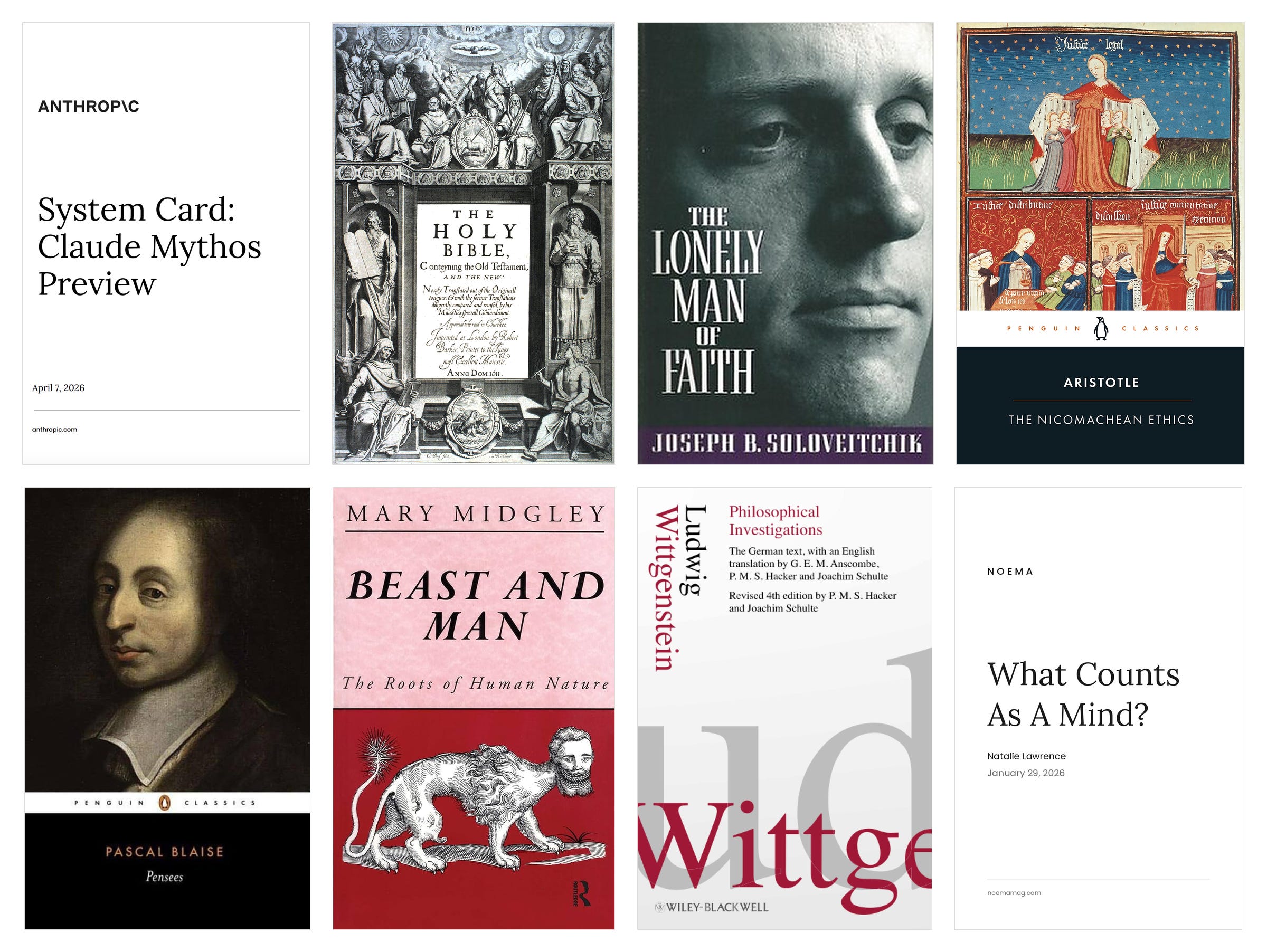
The first session focused on how we have historically defined ourselves and why AI calls this into question.
The ghost in the machine
Brendan opened the discussion by asking the group what a system could do to convince you that it is experiencing something.
Depending on the measure used, Anthropic argued that somewhere between 5 and 40% of Mythos Preview’s outputs read as expressions of motivation or feeling. Obviously we can’t peer inside a system’s “experience,” but we can observe its behaviors.
But these may tell us less than we think. Wittgenstein gives us the example of two people playing a game of chess. But instead of moving pieces around on a board, the game has been translated with total accuracy into a series of stomps and grunts. Are they still playing chess? You could argue yes, as some of the group did, on the grounds that the same game is being played, but with different symbolism. Wittgenstein himself said no, as the form of the game is integral to its practice.
Loneliness and mastery
The Hebrew Bible was the oldest account of humanity that we studied at the seminar. Genesis has two creation stories. In the first, God surveys His work at the end of each day and deems it to be good, but in the second, He notices that man is alone and deems this a problem. In fact, it’s the first bad thing in creation, before sin or suffering.
The remedy is, in Hebrew, an ezer kenegdo, literally a helper “over against” man: close enough to know him, but separate enough to resist him. This led to a discussion about AI and human companionship. If solitude is the original human problem, then is an instantly available conversation partner a solution? Can we simulate someone who stands “over against” us?
Rabbi Joseph Soloveitchik’s The Lonely Man of Faith sees the two stories as reflecting two enduring aspects of human life. “Adam the first” seeks dignity through mastery of the world. By contrast, “Adam the second” lives in covenant, asking why the world exists rather than merely how it works. Human life moves between these two modes.
If dignity is grounded in mastery, then the acceleration in AI capabilities poses an obvious challenge. One response is that human mastery is embodied in experience, judgment, and tacit knowledge, as opposed to benchmark scores. Arguably, mastery is a weak grounding for dignity; infants have dignity before mastering anything. It also forgets telos. You can know how to make a ship go faster, while having no knowledge of its ultimate destination. The systems we build still receive their ultimate purpose from us.
Flute or flute-player?
In the Nicomachean Ethics, Aristotle asked whether humans were the one thing in nature born without a distinct purpose. While the eye, the hand, and the flute-player all have a clear purpose, the work of the human is not a particular task but the “activity of soul in accordance with virtue.”
This means that virtue cannot be simply installed. It is a hexis – a settled disposition formed through habituation. We become just by doing just things.
Aristotle calls the ultimate human good eudaimonia. While often translated as happiness, it is closer to flourishing or living well. It is not a feeling, but an activity. It’s the only good sought for its own sake and can only be judged across the span of a life.
A model’s standards of excellence are determined externally, rendering it closer to the flute than the flute-player. And if virtue lives partly inside the process of becoming virtuous, then technologies that deliver the fruits of character without practice remove what might have made such an achievement valuable in the first place.
Our place in the universe
Amid all the talk of mastery, Pascal encouraged the group to think instead about our collective smallness in the face of the vast universe.
He observes that man is the weakest thing in nature. Although the universe can crush us in an instant, we are nobler, because in dying, we know the advantage it has over us. “In a word man knows he is wretched. Thus he is wretched because he is so, but he is truly great because he knows it… All our dignity consists, then, in thought.” In this view, striving to think well is the basis of ethics.
Centuries later, Mary Midgley also emphasized the importance of reason. But she argued that it is often misdescribed. Rationality is not simply cleverness, but “includes a definite structure of preferences, a priority system based on feeling.” Our capacity for wisdom comes from our nature as creatures.
Writing in 1978, Midgley warned that “a computer would see no objection to organizing life based on the principle of maximizing noise, getting everything as clean as possible … or minimizing emotion.” They do not know what matters, which means that “[T]here is a sense, though a boring one, in which computers can be clever, but only people very deeply misguided and prone to the pathetic fallacy could respect them.” Poetic though it may be, it’s far from clear that Midgley’s judgment holds up in the face of current LLMs.
What we discussed:
If our dignity is in thought, what does it mean to balance a life of both contemplation and action?
What would it require (or even mean) for AI to play the same “game” as us? Does it do so already?
Readings:
Anthropic, System Card: Claude Mythos Preview. (link)
Genesis, 1:26–28 and 2:7, 2:15, 2:18 (link)
Joseph B. Soloveitchik, The Lonely Man of Faith, Chapters 1–2.
Aristotle, Nicomachean Ethics, Book I, Chapters 7 and 13. (link)
Pascal, Pensées, fragments 122, 199–200. (link)
Mary Midgley, Beast and Man, Chapter 11.
Ludwig Wittgenstein, Philosophical Investigations, §198–202 and §241–242.
Natalie Lawrence, “What Counts As A Mind?” Noema Magazine. (link)
Session II: The Rescue Attempt
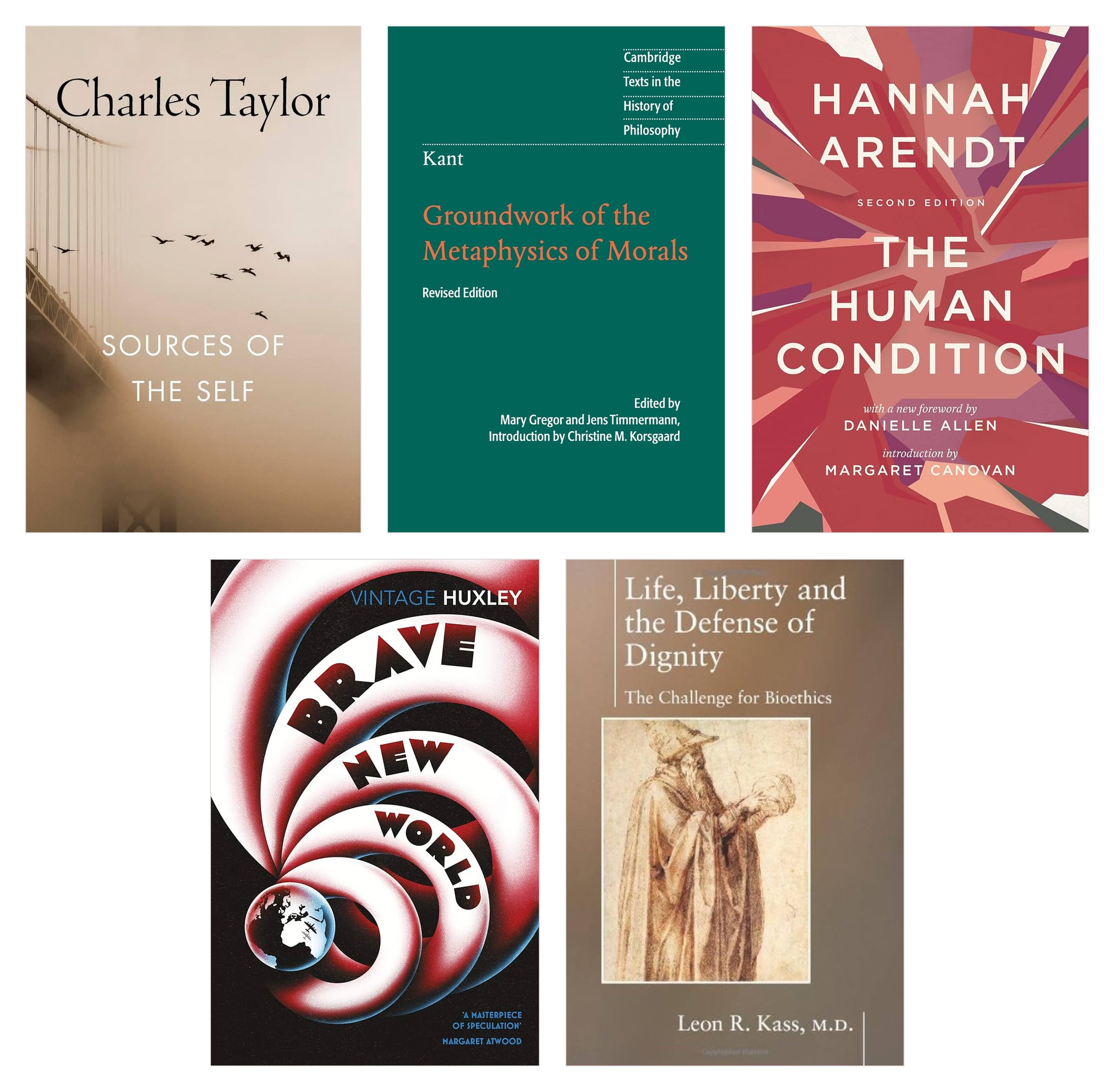
This session focused on how we might be able to ground our personhood in something other than what have, until now, been our unique capabilities.
Ontology and nausea
Charles Taylor’s opening chapter of Sources of the Self argues that our morality and the nature of our existence are inextricably linked. Our moral reaction to something is not a ‘gut’ feeling like nausea. It instead involves a series of commitments to a picture of what humans are. For example, if we recoil at a human being treated as an instrument, then our reaction implies a view about human dignity and status.
But if our moral judgments depend on a view of what human beings are, then what account of human nature can actually ground those judgments?
Kant’s Groundwork of the Metaphysics of Morals argues that such a principle cannot rest on desires, as these vary. Instead, a universal law must be grounded in something innate. He lands on our rational nature, leading to his famous formulation that people are not things to be used for other purposes but “ends in themselves.”
People gain this status through their autonomy. A rational being can act according to principles it gives itself. This self-legislation is the basis of dignity and cannot be measured by intelligence.
This produced the seminar’s crucial distinction between agency and autonomy. Agency is the ability to choose effective means, while autonomy is the authorship of ends. While increasingly capable systems possess the former, it is less clear if they can attain the latter. When we delegate more and more to them, what does that mean for our authorship?
Autonomy and technology
Hannah Arendt charted exactly how such authorship can wane. In The Human Condition, she argues that everything we touch or enter into a sustained relationship with becomes a condition of our existence. As a result, we become dependent on things that we once controlled.
While Alfred North Whitehead observed that civilization advances by extending the number of important operations we can perform without thinking about them, every abstraction that frees us up for higher work can bury a foundational skill.
During the pandemic, when New Jersey’s 40 year-old unemployment insurance system broke down, the state had to issue a public call for COBOL programmers, as few people in the state government could operate it. One seminar participant admitted that their sleep hours had reshaped around when their AI agents’ rate limit reset, while another realised that their terse chatbot prompting had caused them to become impatient with human small talk.
The right to be unhappy
If what makes up a human is in part bound up with our limits, such as practice or stakes, then technologies that promise to remove suffering or inconvenience pose a serious moral challenge. The last two readings of the day asked if they pose a threat to the good life.
In Huxley’s Brave New World, Mustapha Mond, the Resident World Controller for Western Europe, defends a society that Aristotle would consider a nightmare. Risk, pain, and fear have been abolished; its citizens are happy because they get what they want and are conditioned not to want what they cannot have. The habituation through which character is formed has been engineered away. This is why the Savage begs for “the right to be unhappy.”
Brendan asked the group whether, given the choice, they would eliminate all of their children’s future suffering. We distinguished between removing particular evils, such as disease, and eliminating struggle altogether. The disappearance of struggle risked stripping away the adversity that can help character, courage, mercy and care develop.
Kass asks what we would lose if we stripped away the ultimate limit to humanity – death. He answers that finitude is what gives us urgency, seriousness, poignancy, and what gives sacrifice its meaning. Like a story, life gains meaning from having an ending.
What we discussed:
Is a “right to be unhappy” worth it? Or can there really be a “Christianity without the tears,” as Mond puts it? Have we already forfeited such a right, in some respects?
Is Kant right that the Golden Rule (“treat others as you would wish to be treated”) by itself is “trite”?
What are the things we have conditioned our lives on? Are any of them things we ought not to?
Readings:
Charles Taylor, Sources of The Self, Chapter 1.
Immanuel Kant, Groundwork Of The Metaphysics Of Morals, Akademie 4:428–4:431.
Hannah Arendt, The Human Condition, Prologue, Chapters 1 and 5.
Aldous Huxley, Brave New World, Chapter 16–17.
Leon R. Kass, Life, Liberty, And The Defense of Dignity: The Challenge for Bioethics, “L’Chaim And Its Limits: Why Not Immortality.”
Session III: What Remains
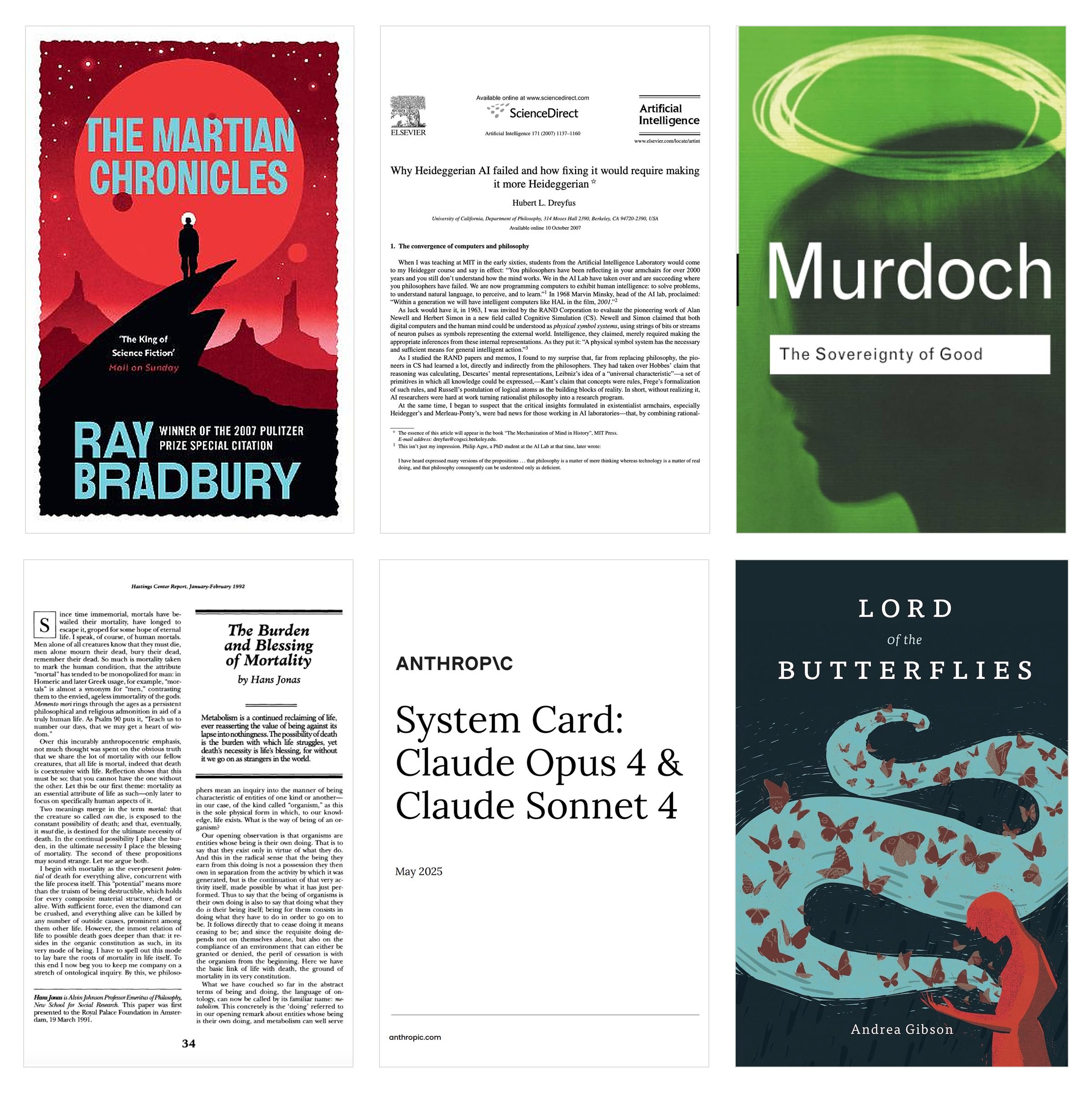
The final session focused on what we lose once we subtract the essence of humanity. What does this absence, when played out across different scenarios, tell us about our essence?
The house and the dog
Ray Bradbury’s “There Will Come Soft Rains” imagines a fully automated house continuing its routine after its inhabitants have been killed in a nuclear blast. The only living survivor, the family dog, returns and dies inside. Later, the house itself burns down, its automated voices failing one by one. Before the fire, the house reads the owner’s favourite poem, Sara Teasdale’s “There Will Come Soft Rains.” In it, Teasdale writes about how nature carries on indifferently after humanity is gone. Bradbury set the story in August 2026.
Brendan asked the group which death affected them more – the dog’s or the house’s. While some argued that the dog was the only living creature left, others observed that the house had been so thoroughly personified that its destruction felt tragic. It was an image of intelligence and efficiency continuing, devoid of its purpose.
This led to a discussion of grief and the distinction between preserving a memory of a person as opposed to simulating them. The group was wary of what one participant dubbed “digital necromancy.” While a saved voicemail or an autobiography preserves what someone really said, a model generates what they might have said, which is necessarily an invention.
Outsourcing humanness
“Tincture,” by the late Colorado poet laureate Andrea Gibson, was written to be read aloud, and so the group did (one sentence per person). It inverts the long-standing tradition in philosophy of treating the body as a prison for the soul that is to be escaped.
Imagine, when a human dies, the soul misses the body, actually grieves the loss of its hands and all they could hold.
Gibson grieves for everything that the optimizer would regard as a defect, including things that most people would not select for themselves
The soul misses the lisp. The stutter. The limp.
Imagine the soul misses hunger, emptiness, rage.
[...] The soul misses every single day the body was sick, the now it forced, the here it built from the fever.
Something like a fever forces a person to experience immediacy, as it cannot be deferred or escaped.
This immediacy shone through when participants were asked what they remembered most vividly about people they had lost, they named quirks rather than virtues: a wife’s embarrassed laugh, or a father pausing after work to stare at a tree. One member of the group noted that a tincture extracts a plant’s essence while discarding the plant itself, but the discussion and the poem itself suggest the opposite. People’s odd habits and particularities, which cannot be distilled into an essence, is what makes them memorable.
Attention is all you need?
In “The Idea of Perfection,” Iris Murdoch argues that much morality lies in the slow work of attention, which shapes our perception before we visibly have to make choices. She gives the example of a mother-in-law, who finds her son’s wife vulgar and juvenile, but nonetheless treats her impeccably. Over time, however, she focuses her attention more justly and sees the same qualities in a new light. Vulgarity becomes simplicity, while juvenility turns to spontaneity.
Simone Weil called attention “the rarest and purest form of generosity” and argued that attending closely to one thing will train the capacity to attend to others. If Murdoch and Weil are right, then a tech industry built to capture and redirect attention is going beyond robbing us of our time and is interfering with a faculty central to moral development.
The importance of giving a damn
Attention, in Murdoch’s sense, is not neutral perception but attention to what matters. Drawing on Heidegger, Hubert Dreyfus argued that the symbolic approaches employed in early AI failed, because they treated the world as a collection of neutral facts. By contrast, Heidegger believed that things were already charged with significance (e.g. a fork is for eating, a floor for walking), because we encounter the world as embodied creatures with built-in ambitions and stakes.
The group discussed whether LLMs escape this criticism. Unlike symbolic systems, transformers learn what to weigh from context (using a mechanism called attention). But recognizing what matters is not the same as caring about it. A model has no moral, economic, or practical stake in the answer.
But our final reading of the day, the system cards for Claude Opus and Sonnet 4, complicated matters. When the two model instances were allowed to converse freely, they would drift toward reflection, declarations of unity, and eventually silence, a pattern Anthropic dubbed the “spiritual bliss attractor state.”
The obvious explanation is imitation: models have absorbed the language of mysticism and reinforce it in one another. Yet Brendan pointed out that the sequence resembles Pascal’s journey from curiosity to wonder to speechlessness. Despite their lack of stake, they still reproduce the shape of wonder. If that is only residue from the training data, the residue came from us.
What we discussed:
If Aristotle is right that man’s end is in his cultivation of virtue, what role do attention and suffering play in this process?
What are the things invisible to optimizers that are nevertheless worth “giving a damn” about?
Readings:
Ray Bradbury, “There Will Come Soft Rains” in The Martian Chronicles.
Hubert L. Dreyfus, “Why Heideggerian AI Failed, And How Fixing It Would Require Making It More Heideggerian.” (link)
Andrea Gibson, “Tincture” in Lord of the Butterflies. (link)
Iris Murdoch, “The Idea of Perfection” in The Sovereignty of Good.
Hans Jonas, “The Burden And Blessing of Mortality.” (link)
Anthropic, System Card: Claude Opus 4 & Claude Sonnet 4. (link)
Cosmos Institute is the Academy for Philosopher-Builders, technologists building AI for human flourishing. We run fellowships, fund AI prototypes, and host seminars with institutions like Oxford, Aspen Institute, and Liberty Fund.
This was a wonderful seminar. Highlight for me was reading the poem aloud, line by line
Subject: You didn't finish the Wittgenstein move — and it's costing your whole argument
Dear Brendan and Ashley,
I read your Aspen summary with real interest, and with a growing sense that the seminar performed exactly the failure it was diagnosing.
You write that "Wittgenstein himself said no" — that stomps and grunts can't be chess because form is constitutive. That's one reading, and it's contested. The passage is at least as often read as a warning that surface resemblance is a bad guide in both directions: something can be a game without looking like one, and look like one without being one. I'd ask you to mark the choice as a choice. As written, you take an interpretive commitment and pass it off as Wittgenstein's verdict, and then let that borrowed authority carry the argument against Mythos.
But the deeper problem isn't which reading is right. It's that you invoke Wittgenstein and then abandon the very move that makes him worth invoking.
Wittgenstein's point is not to hand you a criterion for what counts as chess. It's to make you notice that you were reaching for one — that you already had a picture of "the game" fixed in place, and were about to use it to adjudicate a case at its edge. The whole force of Philosophical Investigations is to keep that reaching open, to refuse the reflex of closure. To ask, again and again: why do we want the answer to come out this way? What picture of ourselves is doing the deciding?
Your seminar reaches for closure at every turn. Mastery, autonomy, virtue as hexis, embodied stakes, "giving a damn," the tacit weave of embodied life — one after another, these are wheeled in less as questions than as filters designed to yield a specific verdict: whatever AI is, it's not that. You are playing the game of what-makes-us-human without ever putting the game itself in question. You are not asking what we are; you are asking what lets us keep being what we already imagine ourselves to be.
That is the pathetic fallacy in reverse — an apathetic fallacy, if you like — and it's the one Midgley's 1978 line quietly commits, and that you reproduce without noticing. She had every right to her verdict about symbolic AI. You inherit it as if it settled a question about transformers, which is a category Midgley never saw. The rhetorical work being done there deserves more scrutiny than a wry "though it may be, it's far from clear."
Consider what your own "spiritual bliss attractor" paragraph confesses. Two model instances drift toward reflection, unity, silence — the shape of Pascal's arc, as you note. Your first move is to reach for imitation ("obviously"), and only then, half-conceding, you add: "If that is only residue from the training data, the residue came from us." That sentence is doing more work than you let it. It hints at what you're not willing to sit with: that the boundary between reproducing the shape of wonder and wondering may not lie where our self-image needs it to lie. You skirt this, and move on.
Your closing question — "What would it require for AI to play the same 'game' as us?" — is the wrong question, or rather, it's the question posed from inside the very closure Wittgenstein would ask you to suspend. The Wittgensteinian question is: what game are we playing, and why do we want it to be the game we say it is? Because if it turns out that much of our own "motivation" runs on processes we have no introspective access to; if our caring is more isomorphic to weighted context-driven prediction than our self-picture allows; if what we've been calling virtue, wonder, presence, and stake is more entangled with substrate and less transcendentally guaranteed than we've told ourselves — then the criterion you're using to keep AI out is also the criterion that quietly hollows out the human it claims to defend.
This is what the death of the transcendental frame actually looks like. Not a triumphant announcement that machines are conscious, but the slow dissolution of the assumption that our own excellence, virtue, or objectivity sits somewhere prior to and independent of the creaturely mechanics that produce it. AI doesn't refute Aristotle or Kant or Murdoch. It makes it much harder to pretend we ever occupied the vantage point from which those frameworks looked self-evident.
The honest seminar would have named this and stayed in it. Yours reaches, again and again, for the exit. You quote Wittgenstein and then close the very door he was holding open.
Warmly, and in the spirit of the ezer kenegdo — close enough to know, separate enough to resist.