


The university is under siege.
Harvard, sitting on a $57 billion endowment, slashed 75 percent of its science and 60 percent of its humanities PhD admissions. Indiana mandated the elimination of over 400 degree programs at its public universities. Classics, comparative literature, and foreign languages at the state flagship are gone. At the University of Tulsa, a philosopher built a Great Books honors college from scratch, grew enrolment 500 percent, and attracted a quarter of each freshman class to a curriculum running from Homer to Arendt. The university removed her.
Sixty-four small colleges have closed since 2020, and the demographic cliff, a 13 percent decline in college-age students projected through 2041, hasn’t even started.
Meanwhile, 52 percent of recent graduates are working jobs that don’t require the degree that they borrowed $30,000 to get. Palantir CEO Alex Karp is telling young people to skip elite colleges entirely, saying the only paths left are skilled trades or neurodivergence.
AI will accelerate this. The skills the degree was supposed to impart – researching, analyzing, drafting, coding – are increasingly things a machine can do.
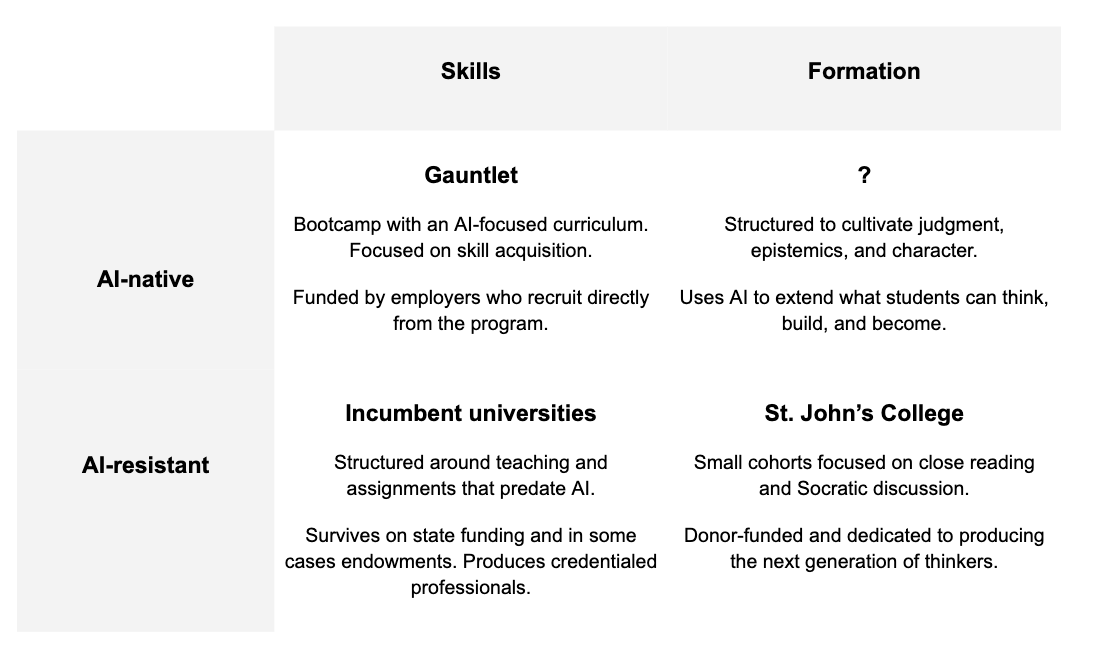
As the old institutions break down, a new generation of educational founders is running experiments. New schools are emerging, each making a different bet on two questions that anyone building an educational institution has to answer:
The first question is about purpose. Do you focus on specific, trainable skills, or on a broader, if more intangible formation, which includes the development of judgment, attention, and moral seriousness?
The second question is about technology. Do you build AI into the core of the educational experience or keep it out because the difficulty is where the learning happens?
These two axes produce a landscape.
At one end, programs like Gauntlet train elite AI engineers in ten weeks: 80-100 hours a week of building, a guaranteed $200K job offer at the end, costs paid entirely by employers.
At the other, institutions like St. John’s College run intensive liberal arts programs built on sustained attention and close reading, with no AI in sight.
Arizona State has embedded AI from coursework to advising and has struck partnerships with a number of high-profile AI companies, but the core teaching model hasn’t changed.
The University of Austin has proposed splitting the day between device-free seminars and intensive AI work.
Meanwhile, the bulk of the higher-education system is either banning AI from the classroom or pretending that it doesn’t exist.
These questions are not new. They go back to the founding of the first American colleges and European research universities.
In partnership with Liberty Fund, Cosmos held a seminar to think through them with a group of founders, scholars, and institution-builders. The participants included philosophers from UT Austin and Ohio State, researchers from MIT Media Lab, RAND, and leading AI labs, education policymakers from the Texas Higher Education Coordinating Board, and builders from Fractal Tech and Alpha School.
The reading list we assembled traces these tensions to their origins: from the earliest American proposals for public education through the founding documents of the research university, the mid-century debates about liberal learning, and the first serious writing about what computers might do to the relationship between learner and knowledge.
Session I: The Promise and Crisis of the University
We are not the first to ask what the university is for.
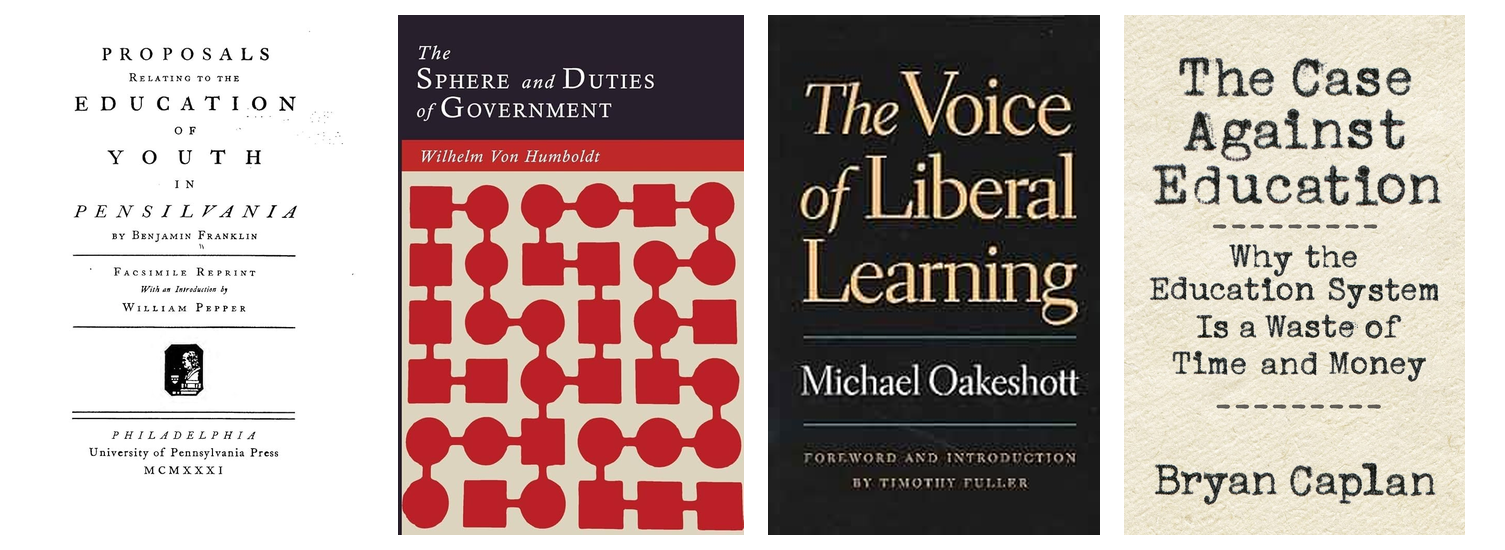
This session combined five voices, spanning three centuries. Franklin wants a practical institution for a practical republic. Humboldt argues that the university exists for the development of the whole person, not the production of useful professionals. Oakeshott insists that education is how a human being becomes one. Bloom diagnoses what happens when that inheritance is abandoned. And Caplan asks whether the whole enterprise is a $240,000 receipt that signals you can show up on time.
If Caplan is even partly right, the reformers need to explain what they are offering that a credential cannot capture. If Humboldt is right, the reformers need to explain why two centuries of institutions built on his model ended up producing exactly the credentialism he warned against.
Benjamin Franklin, Proposals Relating to the Education of Youth in Pennsilvania. (link)
Wilhelm von Humboldt, “On the Internal and External Organization of the Higher Academic Institutions in Berlin”. (link)
Michael Oakeshott, The Voice of Liberal Learning, Introduction.
Allan Bloom, “Our Listless Universities.” (link)
Bryan Caplan, The Case Against Education, Chapter 1, “The Magic of Education.”
Session II: What Formation Requires
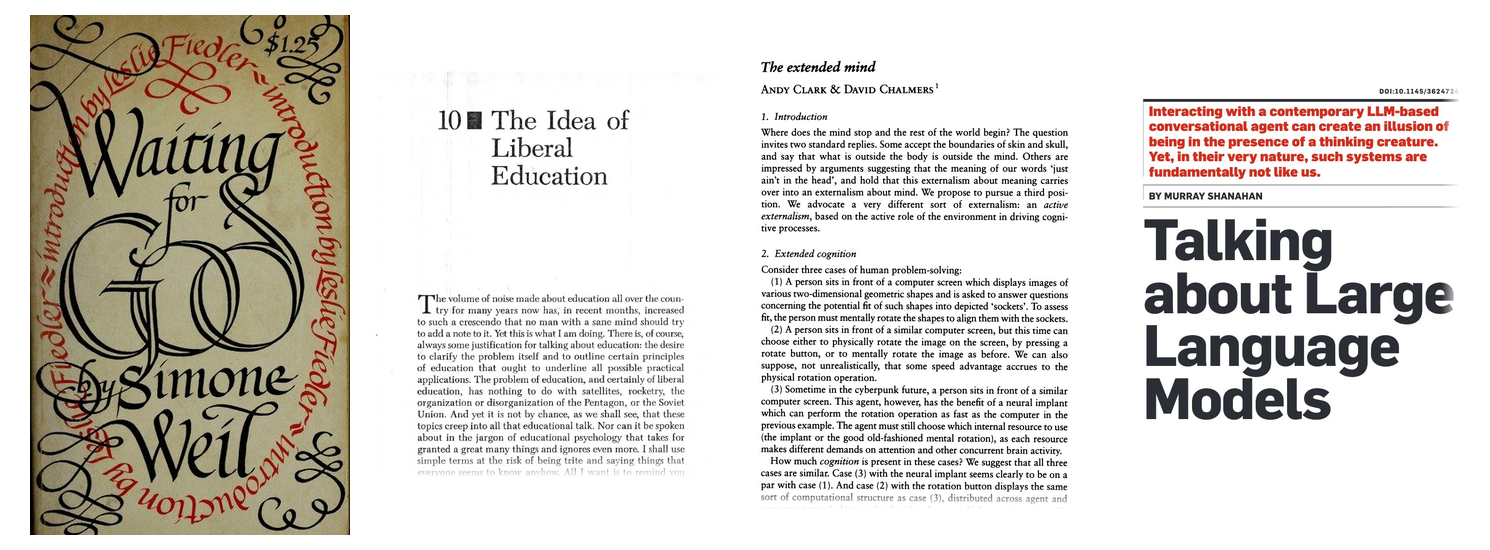
If the first session asked what the university is for, the second focused on what actually changes a person. Weil makes the strongest claim: attention is all you need. Klein argues that liberal education requires putting your own opinions genuinely at risk, and that the resistance to doing so is rooted in something specifically human: we build our identities on what we think we know. Gadamer argues that practical wisdom cannot be taught as a curriculum; it grows out of ethos, the character already formed by living in a particular community.
But what if the boundaries of the person aren’t where we think they are? Clark and Chalmers ask whether cognition is even confined to the skull. If the mind extends into the tools and environments we think with, what counts as “the student”? Shanahan complicates the picture further: LLMs create a compelling illusion of understanding, but they are fundamentally unlike us. If formation requires genuine encounter with other minds, what happens when the most available interlocutor is a machine?
Simone Weil, Waiting for God, “Reflections on the Right Use of School Studies with a View to the Love of God.”
Jacob Klein, “The Idea of Liberal Education” in The Goals of Higher Education, ed. W.D. Weatherford, Jr.
Hans-Georg Gadamer, “The Socratic Question and Aristotle”, Continental Philosophy Review.
Andy Clark and David Chalmers, “The Extended Mind”, Analysis. (link)
Murray Shanahan, “Talking about Large Language Models”, Communications of the ACM. (link)
Session III: The Institutional Question
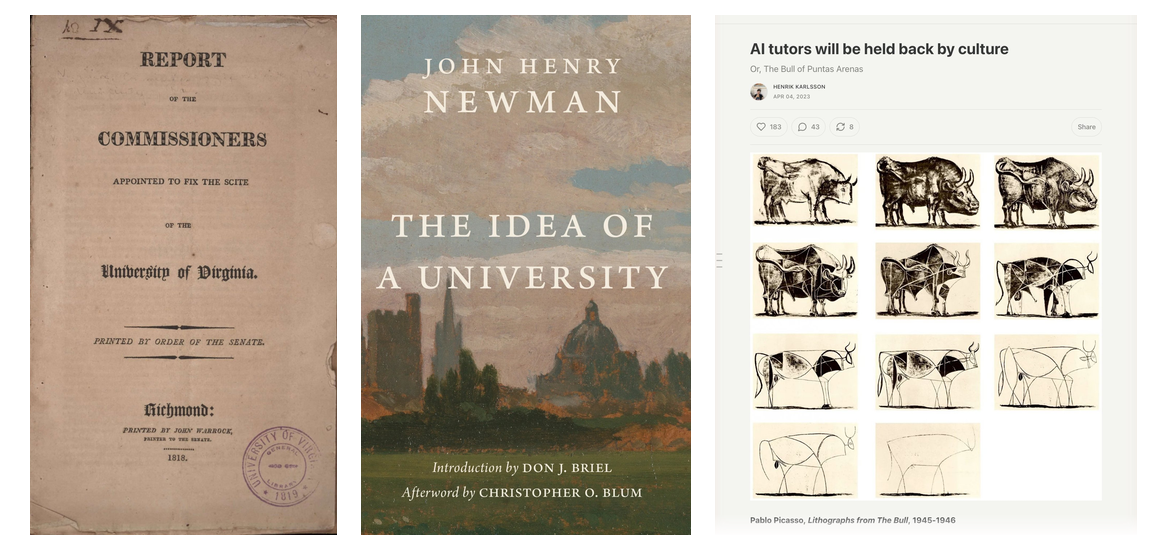
Good ideas about education are easy. Institutions that embody them are hard. This session focused on the gap. Jefferson proposes education as grafting: implanting something new onto the wild stock of human nature. Newman argues that the value of a university lies in the sheer density of its intellectual community, that students gain from living among those who represent the whole circle of knowledge even if they can never study it all.
Karlsson brings this into the present. His argument is sobering: AI tutors will be held back by culture, rather than technology. Motivated learners embedded in high-growth communities will use AI to accelerate, while everyone else will use it to avoid difficulty. The real challenge will be building strong cultural norms against taking the path of least resistance.
Thomas Jefferson, “Draft of the Rockfish Gap Report of the University of Virginia.” (link)
John Henry Newman, The Idea of a University, Discourse 5, “Knowledge its Own End.” (link)
Henrik Karlsson, “AI tutors will be held back by culture.” (link)
Session IV: Education and the Machine
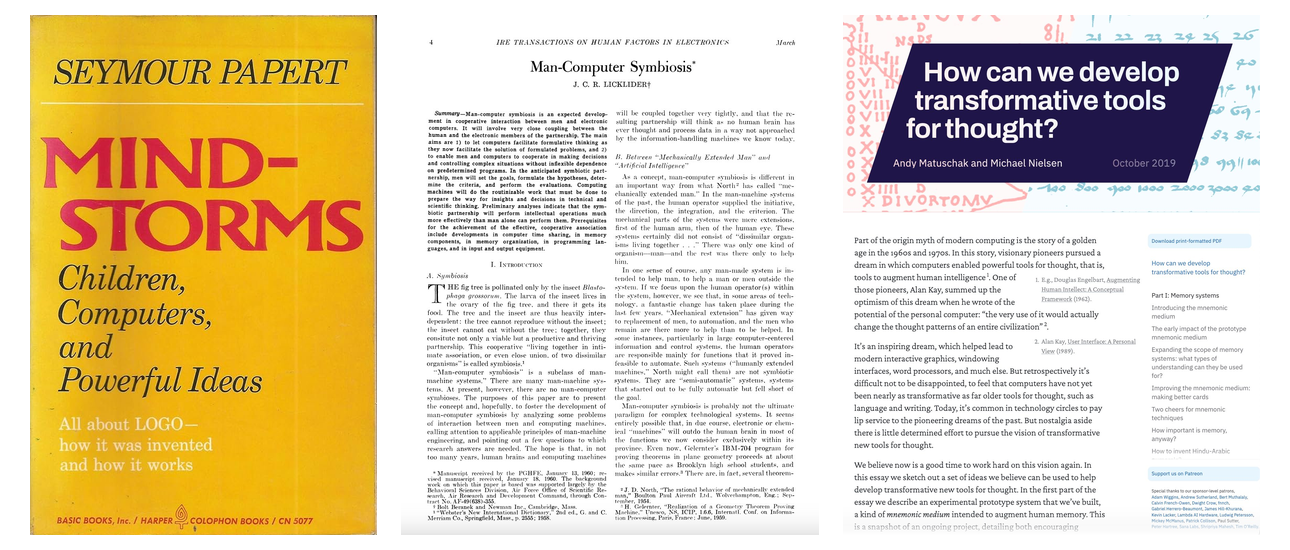
This session turned directly to the question of what technology does to thinking. Licklider, writing in 1960, imagined a partnership: machines handle the routine cognitive work, freeing humans for insight and decision. Papert envisaged a more profound interplay. He argued that when a child learns to program, the relationship between learner and knowledge is fundamentally transformed. The child is no longer receiving explanations but building things, and the building changes how she thinks.
Matuschak and Nielsen pick up the thread sixty years later and find it frayed. The pioneering visions of tools for thought are treated as nostalgia in technology circles. There is little determined effort to build tools that genuinely transform how people understand. The discussion focused on whether the current wave of AI represented a chance to revive the Licklider-Papert vision or whether tools for thought were likely to become an even more distant memory.
JCR Licklider, “Man-Computer Symbiosis,” IRE Transactions on Human Factors in Electronics.
Seymour Papert, Mindstorms: Children, Computers, and Powerful Ideas, Ch. 1.
Andy Matuschak and Michael Nielsen, “How can we develop transformative tools for thought?” (link)
Session V: Building the New Academy
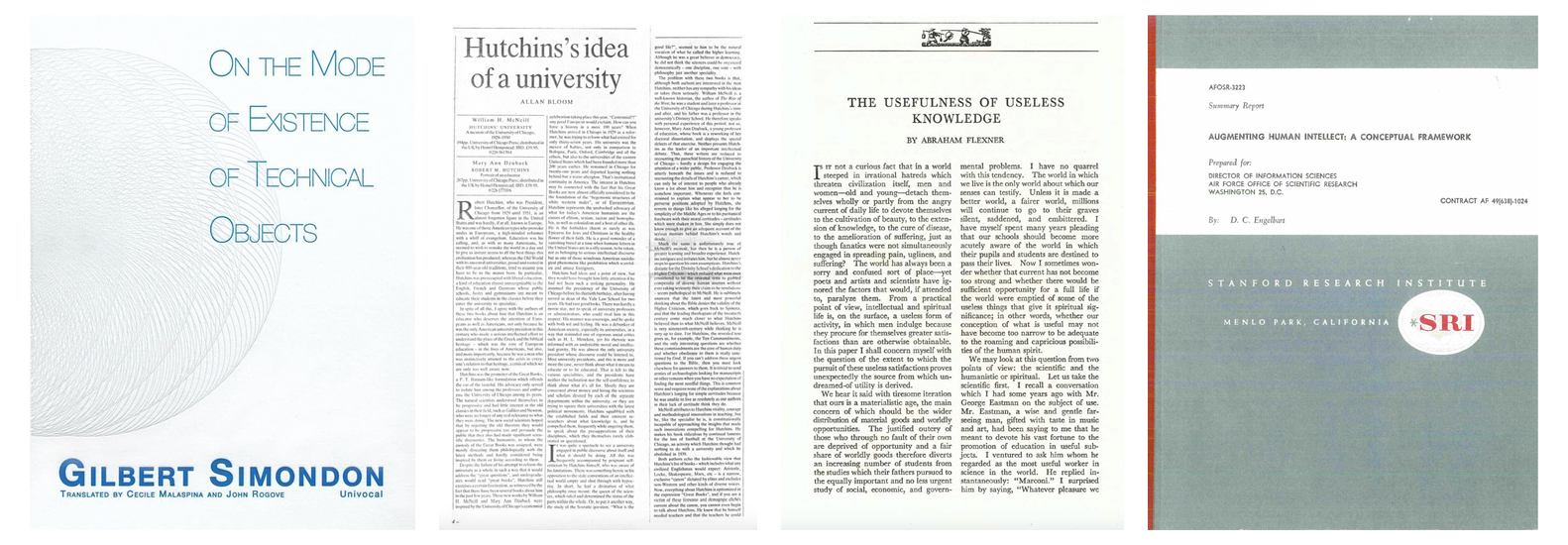
The final session focused on what comes next. Flexner’s defense of useless knowledge, written from the Institute for Advanced Study, is the purest case for protecting inquiry from the demand for application. Bloom’s portrait of Hutchins at UChicago shows what it looks like when someone actually tries to build an institution around these convictions, and the political will it requires. Simondon challenges the premise that technology and culture are opposed, arguing that the hostility between them is a sign of ignorance.
Engelbart closes the list with a constraint AI is testing: “The entire effect of an individual on the world stems essentially from what he can transmit to the world through his limited motor channels.” As those channels widen, the bottleneck shifts to whether you have something worth transmitting.
Alexander Flexner, “The Usefulness of Useless Knowledge,” Harper’s Magazine. (link)
Allan Bloom, “Hutchins’s Idea of a University,” Times Literary Supplement.
Gilbert Simondon, On the Mode of Existence of Technical Objects, “Introduction.”
Douglas C. Engelbart, “Augmenting Human Intellect: A Conceptual Framework,” SRI Summary Report AFOSR-3223.
Is there an institution that protects the conditions for deep formation and teaches students to master the tools that will define their century?
Cosmos Institute is the Academy for Philosopher-Builders, with programs, grants, events, and fellowships for those building AI for human flourishing
It is difficult to get many of the people I talk with to understand the value of critical thinking, because all their lives they’ve successfully done jobs that didn’t require it. Now a machine is doing those jobs and they are asking me what online college major will lead them to a good job with stable income.. but the new world requires more effort.
Alpha school uses intrinsic motivators to push K-12 learners to achieve mastery in basic subjects. But at the level of higher ed, I think that the motivation has to come from within. A scholar needs intense curiosity along with the willingness to put in lots of effort. I suspect that a community of similarly motivated individuals can help to foster that. The true scholar will let AI challenge him to become better. The more transactional student will not seek out challenge.