


Today’s essay is a guest post from Devin Stauffer, Professor of Government at the University of Texas at Austin and a Cosmos Founding Fellow.
As a professor at the University of Texas at Austin, I sense in my students, as I’m sure many other professors sense in theirs, a growing anxiety about AI. Although students sometimes express optimism about AI’s potential to accelerate innovation, more vivid and striking is their fear that AI will make it harder for them to live vigorous, engaged, and autonomous lives. One of my challenges is to convince them that the kind of books I teach, the Great Books, can still speak to them in the age of AI.
This isn’t easy. The Great Books—books like Homer’s Odyssey, Plato’s Republic, Machiavelli’s Prince, and Shakespeare’s plays—were written in times very different from our own, for people who didn’t have a world of information at their fingertips, and in societies that faced challenges that are barely recognizable to us.
It’s not entirely unreasonable for students to suspect that the Great Books of the past no longer have much to say to us and that they’ve become historical relics that belong in dusty museums rather than in the hands of contemporary readers. But it would be a terrible mistake to draw this conclusion. In my view, the Great Books should be regarded as more precious than ever, both for the habits of mind they cultivate and for the questions they raise.
Entering ancient courts
It is true—and some might take it as evidence that Great Books are no longer relevant—that reading the Great Books is becoming increasingly counter-cultural, at least in the sense that it involves an activity that runs ever more contrary to the mental habits of our time. We live in an age of maximum information but minimum reflection. That, however, is a reason one should read the Great Books. In his 1978 Harvard address, Aleksandr Solzhenitsyn described “hastiness and superficiality” as “the psychic diseases of the 20th century.” He wasn’t wrong, but he hadn’t seen anything yet.
TikTok, Instagram, and AI have vastly surpassed TV and radio in their power to distract and trivialize, and they have worked together with other forces to spread those diseases like a global epidemic in the 21st century. But that makes any and all antidotes valuable. There is perhaps no greater antidote to hastiness and superficiality than reading the Great Books, which can’t be read well without slowing down, taking one’s time, and reflecting as deeply as one can on complex arguments and profound reflections.
There is a beautiful passage in a letter he wrote to a friend in which Machiavelli describes how he spent a typical day during a bittersweet period in which he was living in political exile. As he tells his friend, he spent his day doing a bit of this and a bit of that. But then he says:
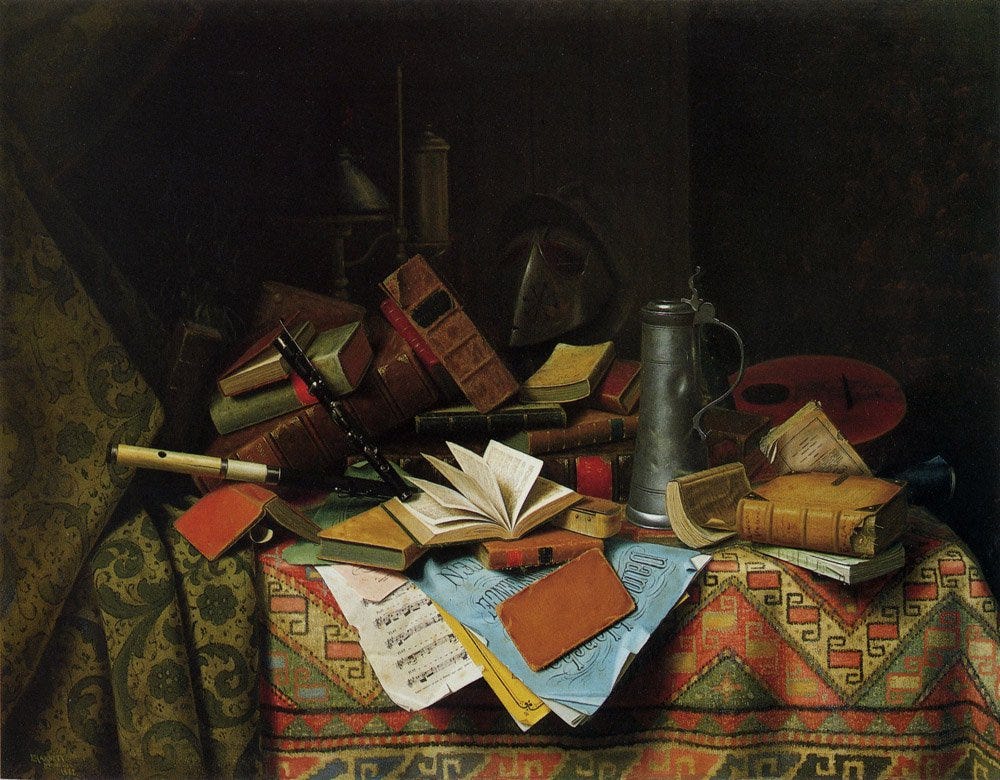
When evening has come, I return to my house and go into my study. At the door I take off my clothes of the day, covered with mud and mire, and I put on my regal and courtly garments; and decently reclothed, I enter the ancient courts of ancient men, where, received by them lovingly, I feed on the food that alone is mine and that I was born for. There I am not ashamed to speak with them and to ask them the reasons for their actions; and they in their humanity reply to me. And for the space of four hours I feel no boredom, I forget every pain, I do not fear poverty, death does not frighten me. I deliver myself entirely to them.
I have always loved that passage because it captures what the experience of reading can be at its best. One would not think that anyone could give a moving description of reading, nor, if it could be done, that Machiavelli would be the one to do it. But there it is. Yet notice what Machiavelli doesn’t say: he doesn’t say that he checked his phone every ten minutes, that he kept getting texts from his friends, that he couldn’t resist looking at Instagram every so often, or that four hours proved to be too much so he shortened things up by turning to AI summaries to get through the hardest chapters.
The experience that Machiavelli describes in that letter runs against the currents of our time. It has become hard for us to have that experience. But that doesn’t mean that it is impossible. In fact, it’s all the more important for us to seek it out precisely because it runs against the currents of our time. Reading as intensely as Machiavelli did can provide a much-needed antidote to our tendency toward distraction, frivolity, and absorption in the churn of the present. Reading the Great Books seriously requires one to cultivate habits of meditation, not by sitting quietly and following one’s breath, but by reading actively, following plots and arguments, and engaging in a dialogue with the great minds of the past. So that is one reason to read the Great Books: to cultivate the habit of deep reflection as a counterweight to our hasty and superficial ways of living through screens, algorithms, and endless diversions and distractions.
But one might be able to cultivate that habit in other ways—by meditating about just about anything, perhaps even one’s own breath, as boring as it would be to do that for four hours. A deeper and better reason to turn to the Great Books concerns not the kind of experience one can have in reading them but the kind of questions they raise and address—their substance, in other words. One of the things that makes the Great Books great is that they contain very rich and very complex treatments of very simple questions. The Great Books, especially the Greatest Books, tend to take up the kind of questions that little kids tend to ask, before the world teaches them that they shouldn’t spend their time thinking about what really matters. Questions like: What is justice? What is the best way of life? Is there one? What kind of happiness can we hope for as human beings? How might we get it? What is virtue or human excellence? What matters more, success or moral goodness? Is there a God? And how does our mortality change what we are when we are alive and shape how we should live?
These are questions that belong to human life as such; they have always gripped thoughtful human beings. But let me focus on another question that the Great Books raise that has become even more pressing in our time because of the rise of AI. One of the new questions AI is forcing us to confront is in fact an old question: What does it mean to be human? Now that we are seeing that a form of “thinking” can be done much better and much faster by machines, we should be led to think about what it means not just to think, but to think as human beings. How should we understand the essence of our humanity? What makes us different from machines? And how should those differences affect how we live, both individually and collectively?
Competing answers
Let’s suppose that one turned to the Great Books to think about that question or that constellation of questions. What would one find? As with the other questions I listed, one would not find an answer—at least not an answer in the sense of a singular answer that all great authors agree upon. The authors of the Great Books rarely agree with each other. That is one of the virtues of reading them, because it compels one to become a participant in a vast debate. Let me pick out two great thinkers who confront the question at issue to make the point.
If one turned to Aristotle to ask about the essence of our humanity, one would find the following set of thoughts. Human beings are defined above all by our rationality, which makes us capable of speech, and by our sense of justice, which makes us especially capable of speech and discussion with each other about matters of justice. Aristotle held the view that human beings are social and political animals who find our fullest flourishing, the fullest activation of our humanity, in communal discussion with others about matters of great moral and political importance. Aristotle would say that you can stick human beings in a zoo or put them out in the woods or strand one on an island (like Odysseus with Calypso), but those are not the places where you will find human beings being human beings in the full sense. Rather, it is in the city, the polis, that we most actualize our humanity by doing what is most distinctively human—by discussing matters of moral and political importance, and not just discussing such matters, but passing judgments and making decisions with serious consequence for our lives.
Because he held this view of our humanity, Aristotle would be deeply worried about the threat AI poses to our humanity. By threatening to take the activities of thinking, debating, discussing, and perhaps ultimately even judging and deciding out of our hands, AI, Aristotle would say, threatens to deprive us of what most makes us what we are. Just as human beings in zoos or in the woods or on islands aren’t able to live fully human lives, so too human beings sitting on couches scrolling through social media feeds while AI does the work of thinking and judging for them are not living fully human lives. They are not living out and developing their highest natural capacities or satisfying their natural craving for social connection and morally serious engagement and discussion with others. It is possible, Aristotle would say, to remain human in a basic sense while living a life that is too easy, too detached, too distracted, and too unchallenging to blossom from the basic bud of humanity into the full flower of a human soul doing what it can at its best.
That’s Aristotle. What about Thomas Hobbes? From Hobbes, one would hear something more like this. Human beings are much more like machines than we might like to think, because everything in the universe, including our so-called souls, is made up of nothing but matter in motion: everything real is body or merely material; there is no such thing as the spirit or the soul as something separate from body or matter.
What sets human beings apart from other animals, according to Hobbes, is, in the first place, not much, and, in the second place, three features of human nature that Aristotle did not emphasize because he was too concerned to paint a rosy picture of our humanity. The first of these is that we pose terrible threats to one another, especially in the absence of a powerful government. By nature, as Hobbes puts it, “man is a wolf to man,” and the state of nature is a war of all against all that leaves human beings living lives that are “solitary, poor, nasty, brutish, and short.”
What life is all about, in Hobbes’s view, is not the joy of discussing justice with our fellow citizens—which discussions, he would point out, often turn into vicious conflicts—but rather the flight from fear and the pursuit of “a perpetual and relentless desire of power after power that ceases only in death.” So we are dangerous to another, and we are always dissatisfied and anxiously seeking to fulfill our desires and assuage our fears by making ourselves as secure and powerful as we can.
And then the third and final thing, which is more optimistic, is that we are the only animals capable of an inventive form of causal thinking. Only human beings, Hobbes observes, can take things we encounter—whatever they may be, including even ourselves—and imagine new uses to which they might be put. This imaginative faculty is the root of our capacity to invent: we can transform ourselves and the world; we can go to work on nature and make it better.
My guess is that Hobbes would be much more welcoming of AI than Aristotle would be, because Hobbes would regard AI as an expression of the human pursuit of power after power, as a new way that human beings have devised of exerting ever greater control over a harsh natural world and making the world a more abundant and secure place in which to live. Nature is terrifying and terrible, in Hobbes’s view, and therefore he wanted to unleash the power of art to combat it. AI is a form of art, perhaps the most extraordinary ever devised. AI is also a form of power-seeking and power-accumulation, and Hobbes thought that human beings naturally want power.
So, although AI is not naturally human, Hobbes would see it as an expression of our humanity. And he would welcome it as a way of using technology to turn lives that nature would render “solitary, poor, nasty, brutish, and short” into lives that are “interconnected, prosperous, comfortable, civilized, and long.”
Human nature
So who is right—Aristotle or Hobbes? I doubt that that is a question any machine could get very far in thinking about, because to think about it well one has to draw from one’s experience of being human and from one’s concerns as a human being. Hobbes urges his readers to look inside themselves to test whether what he says is true, and in a way Aristotle does too. But a machine can’t really look inside itself, or, if it could, what it would find would not be human nature, even if it could compile all sorts of data about what actual human beings have said about human nature. What it wouldn’t find are human experiences—experiences like anger, sadness, hope, longing, fear, and moral passions—which may not exactly be human nature, but which are its manifestation and thus, for us human beings, windows on what it is and what we truly are.
To think well about who is right between Aristotle and Hobbes, one should read their books—not my summaries or AI’s—ponder their arguments, and avoid rushing to conclusions, since both authors were vastly more thoughtful than just about any of us are today. And of course one shouldn’t limit oneself to Aristotle and Hobbes. How, for instance, does Plato’s view that we are deeply erotic beings who yearn for immortality, even as we are also rational beings led to doubt whether what we yearn for is truly attainable, compare with, say, Rousseau’s view that we are naturally content beings who have become dissatisfied only because of vain and artificial concerns that have been foisted on us by society, or with John Locke’s view that we are acquisitive beings who want above all to acquire property that will make us both safe and comfortable?
One of the most remarkable things about being human—one doesn’t need the Great Books to know this, but they help to drive the point home—is that our own humanity is not so transparent to us. We are in a strange way opaque to ourselves. It’s not so clear what we, as human beings, most deeply care about and thus what makes us thrive and what make us wither. In fact, paradoxically, this is perhaps the one thing that can be said with certainty about human nature: that it is a question and a mystery. Human nature is something about which we know something, since we are human and live it every day, but it is also something that we don’t see clearly and therefore something to which the most reflective people in human history have devoted some of their most profound thinking. It is a sign of the complexity of the question that they have reached such different answers.
If human nature were simple, one would expect all who have thought about it deeply, or even shallowly, to have reached the same basic conclusions. But they haven’t, as one will quickly learn by reading the Great Books. That does not mean that the Great Books cancel each other out. It means, rather, that they summon us to reflect on questions whose importance is as real as ever.
Cosmos Institute is the Academy for Philosopher-Builders, technologists building AI for human flourishing. We run fellowships, fund fast prototypes, and host seminars with institutions like Oxford, Aspen Institute, and Liberty Fund.