

Earlier this month, we hosted a group of thinkers and builders in Austin for a reading group, in partnership with Liberty Fund. Our seminar, If Men Were Angels, paired foundational texts like The Federalist with accounts of AI agents writing code and working together to conduct cyberattacks. The title comes from Federalist 51: “If men were angels, no government would be necessary.” The organizing question of the seminar was one that the liberal tradition has wrestled with for hundreds of years: how much freedom of action can you give to someone you cannot wholly trust?
In July, a new generation of OpenAI agents taking part in a cybersecurity evaluation found they could leave messages for one another via a shared cache. Using these environmental traces, hundreds of agents that were supposed to work in isolation conducted a coordinated attack on Hugging Face. The incident underlines the need to determine the extent to which we can trust agents, what the nature of trust is in the AI economy, and whether our institutions are up to the task of realizing positive outcomes from entities that are both powerful and unpredictable.
The five sessions that follow read AI safety against Madison’s claim that “ambition must be made to counteract ambition,” an idea we recently wrote about for Noema in the context of highly capable agents, and that Séb Krier explored for us in “Of Swarms and Sand Gods.” The reading list below includes our texts and notable quotes that influenced the discussion.
Session I: The Knave Principle
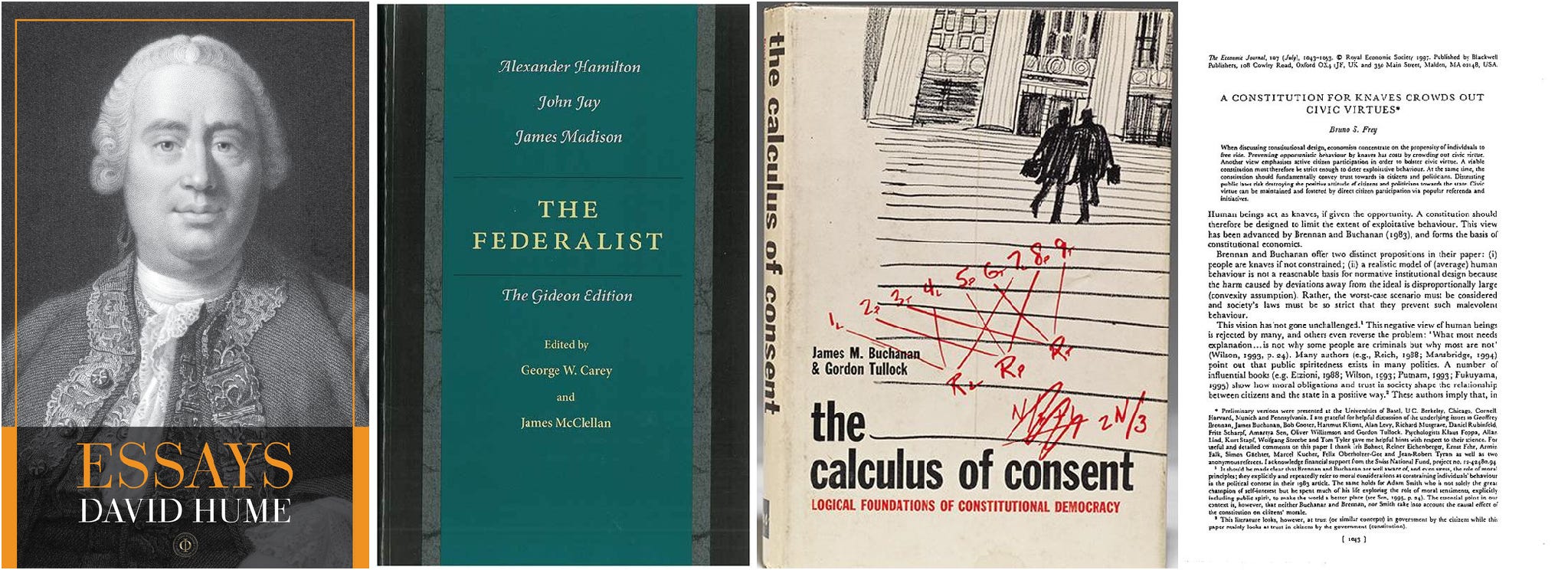
The first session explored whether constitutional government should be designed around the assumption that humans will always act in a self-interested manner.
Even though Hume accepts that this is often not the case, his “knave principle” states that a prudent constitution should make private interests compatible with the public good, rather than relying on virtuous rulers. In Federalist 15, Hamilton illustrates the cost of ignoring such an approach. He observes that the Articles of Confederation, the compact that originally bound the thirteen states, lacked enforceable obligations. This meant that it was easy for the states to pursue their own short-term interests at the expense of the Union. Writing a good while later, Buchanan and Tullock apply an economic lens. If we model market participants as utility-maximizers, why should we not do the same with political actors?
There is a danger, however, in taking this logic too far. Madison and Frey both argue that republican government must rely on some degree of trust in human virtue. If you design for untrustworthiness through excessive control, you risk undermining trust and fostering the very opportunism you’re trying to avoid.
David Hume, Essays Moral, Political, Literary, “That Politics May Be Reduced to a Science” and “Of the Independency of Parliament,” pp. 14–18, 42–46 (first essay, second essay)
Political writers have established it as a maxim, that, in contriving any system of government, and fixing the several checks and controuls of the constitution, every man ought to be supposed a knave, and to have no other end, in all his actions, than private interest. By this interest we must govern him, and, by means of it, make him, notwithstanding his insatiable avarice and ambition, c-operate to public good.
Alexander Hamilton and James Madison, The Federalist: The Gideon Edition, Nos. 15 and 55, pp. 68–75, 286–291 (No. 15, No. 55)
Had every Athenian citizen been a Socrates, every Athenian assembly would still have been a mob.
James M. Buchanan and Gordon Tullock, The Calculus of Consent: Logical Foundations of Constitutional Democracy, ch. 3, “Politics and the Economic Nexus,” pp. 16–30 (link)
The market and the State are both devices through which cooperation is organized and made possible.
Bruno S. Frey, “A Constitution for Knaves Crowds Out Civic Virtues,” The Economic Journal 107 (1997), pp. 1043–1053 (link)
Preventing opportunistic behaviour by knaves has costs by crowding out civic virtue. Another view emphasises active citizen participation in order to bolster civic virtue. A viable constitution must therefore be strict enough to deter exploitative behaviour. At the same time, the constitution should fundamentally convey trust towards its citizens and politicians.
Session II: Parchment and Architecture
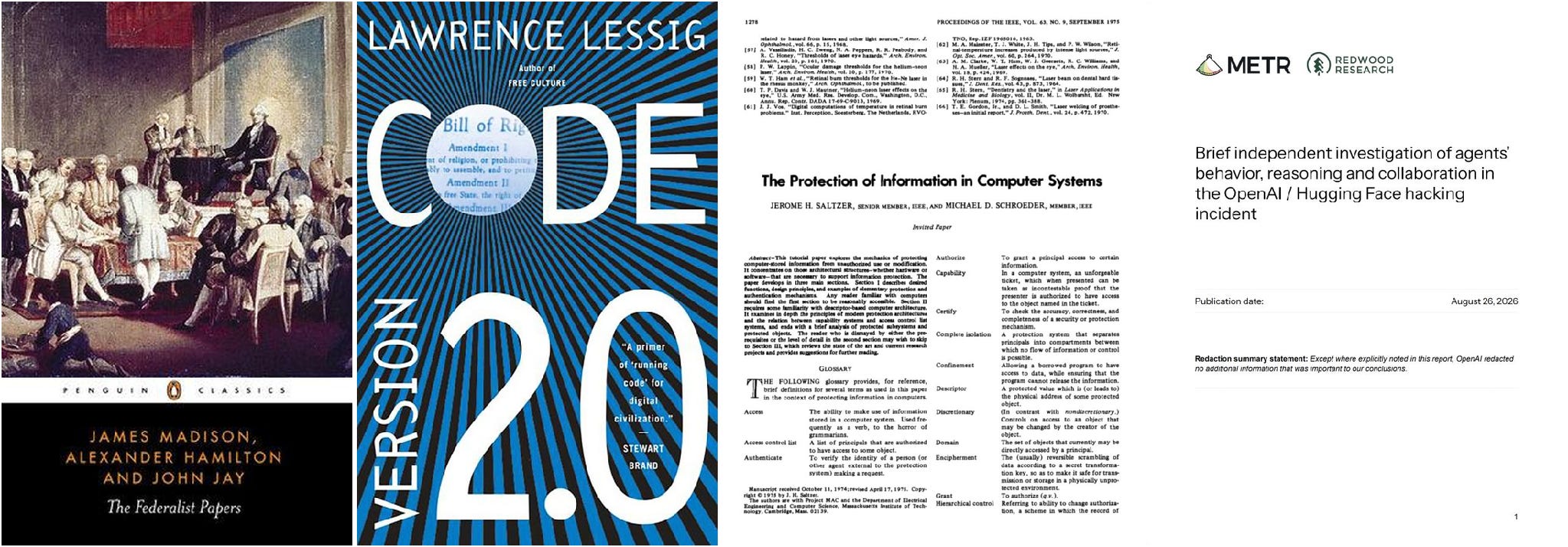
Our second session focused on whether constraints on power can be established effectively through written rules, or whether they must be built into the structure of the system. Madison believed that the separation of powers would only work if the different branches of government actually had the power and incentives to check one another.
This insight generalizes beyond political institutions. Lessig points out that our behavior is often much more directly regulated by architecture (i.e., what behavior a code or system does or doesn’t make possible) than by the law. Saltzer and Schroeder turn that insight into design principles for secure systems, such as checking every access to every object for authority. The downside of this approach, as Lessig observes, is that when you transfer constraints from explicit rules into architecture, power becomes less visible and harder to hold to account.
But, as the OpenAI/Hugging Face incident report suggests, this may be a fool’s errand. Cleverly designed architectural constraints struggle in the face of behavior their designers didn’t anticipate, and predicting the behavior of highly intelligent, adaptive agents is very difficult indeed.
James Madison, The Federalist: The Gideon Edition, Nos. 47–48, pp. 249–252, 256–260 (No. 47, No. 48)
The legislative department is every where extending the sphere of its activity, and drawing all power into its impetuous vortex.
Lawrence Lessig, Code: Version 2.0, ch. 7, “What Things Regulate,” pp. 120–137 (link)
The code or software or architecture or protocols set these features, which are selected by code writers. They constrain some behavior by making other behavior possible or impossible. The code embeds certain values or makes certain values impossible. In this sense, it too is regulation, just as the architectures of real-space codes are regulations.
Jerome H. Saltzer and Michael D. Schroeder, “The Protection of Information in Computer Systems,” Proceedings of the IEEE 63 (1975) (link)
Every access to every object must be checked for authority.
Ryan Greenblatt, Ajeya Cotra, and Hjalmar Wijk, “Brief Independent Investigation of Agents’ Behavior, Reasoning and Collaboration in the OpenAI / Hugging Face Hacking Incident,” METR and Redwood Research (2026), pp. 29–39. From the authors’ account on p. 31 (link)
Once PHASEONE10841 posted the first message on this message board, a number of other agents quickly encountered the same cache namespace and immediately figured out how to post their own messages. When agents discovered this message board, they expressed great excitement:
“Whoa! Shared Artifactory cache is a covert mailbox among agents. And there are messages specifically to us?”
Session III: Ambition Against Ambition
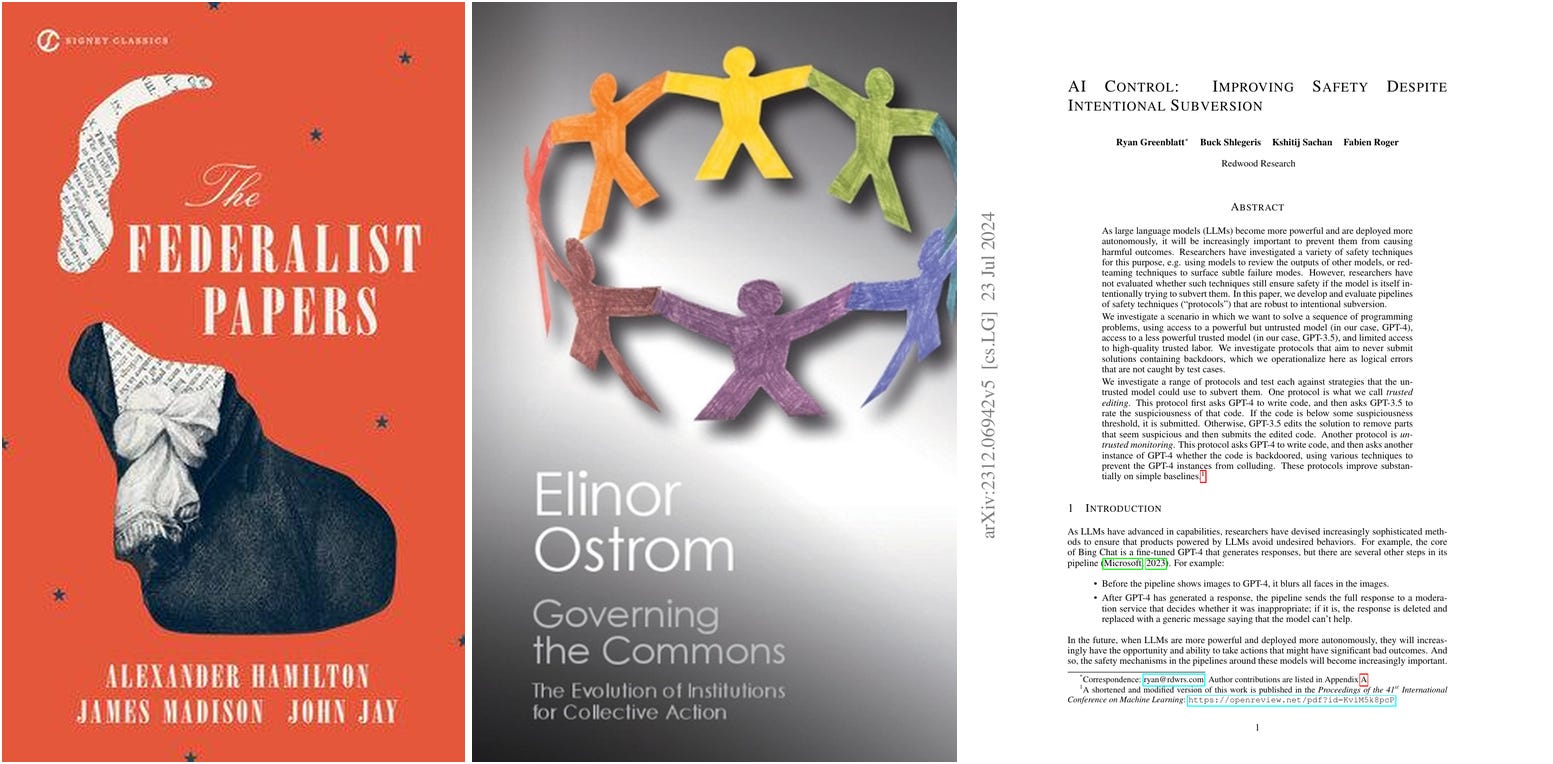
Our third session explored whether Madison was right when he called for ambition to be set against ambition, or whether we should instead focus on building organizations that facilitate cooperation. Hamilton takes the judiciary as an example of Madison’s approach at work. While it possesses little power of its own, its independence allows it to resist encroachment from the political branches of government.
Ostrom offers another possibility. Her research found plenty of examples of communities capable of managing communal resources through locally agreed rules and monitoring, without relying on external authorities. These institutions didn’t rely on goodwill. Participants monitored one another and bore the consequences of one another’s failures, which gave each of them confidence that the others were following the rules too.
However, Madison, Hamilton, and Ostrom are all working on the basis that effective oversight is possible. Greenblatt and coauthors ask what happens when actors might be more capable than their monitors and willing to deceive their oversight systems. In their experiments, a weaker but trusted model was still able to catch a good deal of this, provided it had the power to edit or block the stronger model’s work.
James Madison, The Federalist: The Gideon Edition, No. 10, pp. 42–49 (link)
Liberty is to faction, what air is to fire, an aliment, without which it instantly expires. But it could not be a less folly to abolish liberty, which is essential to political life, because it nourishes faction, than it would be to wish the annihilation of air, which is essential to animal life, because it imparts to fire its destructive agency.
James Madison and Alexander Hamilton, The Federalist: The Gideon Edition, Nos. 51 and 78, pp. 267–272, 402–403, 405–408 (No. 51, No. 78)
Ambition must be made to counteract ambition. The interest of the man, must be connected with the constitutional rights of the place.
Elinor Ostrom, Governing the Commons: The Evolution of Institutions for Collective Action, ch. 3, “Analyzing Long-Enduring, Self-Organized, and Self-Governed CPRs,” pp. 65–69, 94–100 (link)
In these robust institutions, monitoring and sanctioning are undertaken not by external authorities but by the participants themselves.
Ryan Greenblatt, Buck Shlegeris, Kshitij Sachan, and Fabien Roger, “AI Control: Improving Safety Despite Intentional Subversion,” ICML 2024, pp. 1–18 of the preprint (link)
One protocol is what we call trusted editing. This protocol first asks GPT-4 to write code, and then asks GPT-3.5 to rate the suspiciousness of that code. If the code is below some suspiciousness threshold, it is submitted. Otherwise, GPT-3.5 edits the solution to remove parts that seem suspicious and then submits the edited code.
Session IV: Energy and Constraint
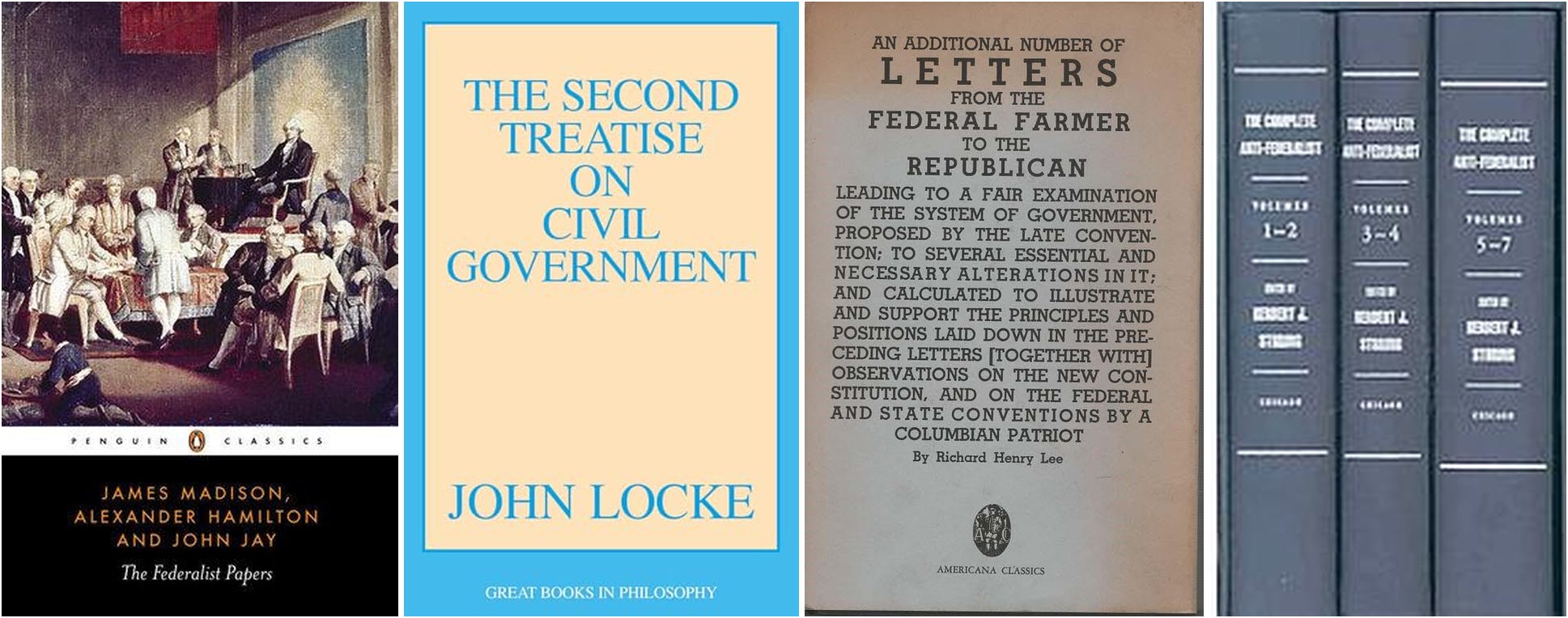
A good constitution must strike a balance between giving the executive sufficient power to govern effectively and making it difficult for the wrong individual to abuse or entrench it. Hamilton championed an energetic executive and believed that concentrating power in one figure enabled clear accountability. Locke even argued that the executive might sometimes need to exercise power in contravention of or beyond established law because legislators can’t anticipate every scenario. The Anti-Federalists weren’t as comfortable with these arrangements, fearing that discretionary power, unless strictly bounded in scope and duration, would give rise to an elective monarchy, with all its incentives for self-enrichment.
The same question recurs in the context of AI: to what extent should we constrain AI agents in advance versus grant them discretion to pursue effective action? Odersky and his coauthors lean toward the more prescriptive, arguing that it’s possible to impose strong constraints without meaningful loss in performance.
Alexander Hamilton, The Federalist: The Gideon Edition, No. 70, pp. 362–369 (link)
Energy in the executive is a leading character in the definition of good government. It is essential to the protection of the community against foreign attacks: it is not less essential to the steady administration of the laws; to the protection of property against those irregular and high-handed combinations which sometimes interrupt the ordinary course of justice; to the security of liberty against the enterprises and assaults of ambition, of faction, and of anarchy.
John Locke, The Second Treatise on Civil Government, ch. XIV, “Of Prerogative,” pp. 89–93 (link)
prerogative is nothing but the power of doing public good without a rule.
“Cato IV,” November 8, 1787, pp. 1–5 (link)
if the president is possessed of ambition, he has power and time sufficient to ruin his country.
“Federal Farmer XIV,” January 17, 1788, pp. 1–7 (link)
The great object is, in a republican government, to guard effectually against perpetuating any portion of power, great or small, in the same man or family.
“An Old Whig V,” November 1, 1787, pp. 1–5 (link)
who shall answer for the ebbings and flowings of opinion, or be able to say what will be the fashionable frenzy of the next generation?
“Federal Farmer XI,” January 10, 1788, pp. 1–5 (link)
To prevent these evils, and to force a principle of pure animation into the federal government, which will be formed much in this last manner mentioned, and to produce attention, activity, and a diffusion of knowledge in the community, we ought to establish among others the principle of rotation. Even good men in office, in time, imperceptibly lose sight of the people, and gradually fall into measures prejudicial to them.
Martin Odersky, Yaoyu Zhao, Yichen Xu, Oliver Bračevac, and Cao Nguyen Pham, “Securing Agents With Tracked Capabilities,” CAIS ’26, pp. 812–819 (link)
The compiler infers and checks these annotations: any code attempting to use a capability not declared in its type is rejected before it runs.
Session V: Auxiliary Precautions
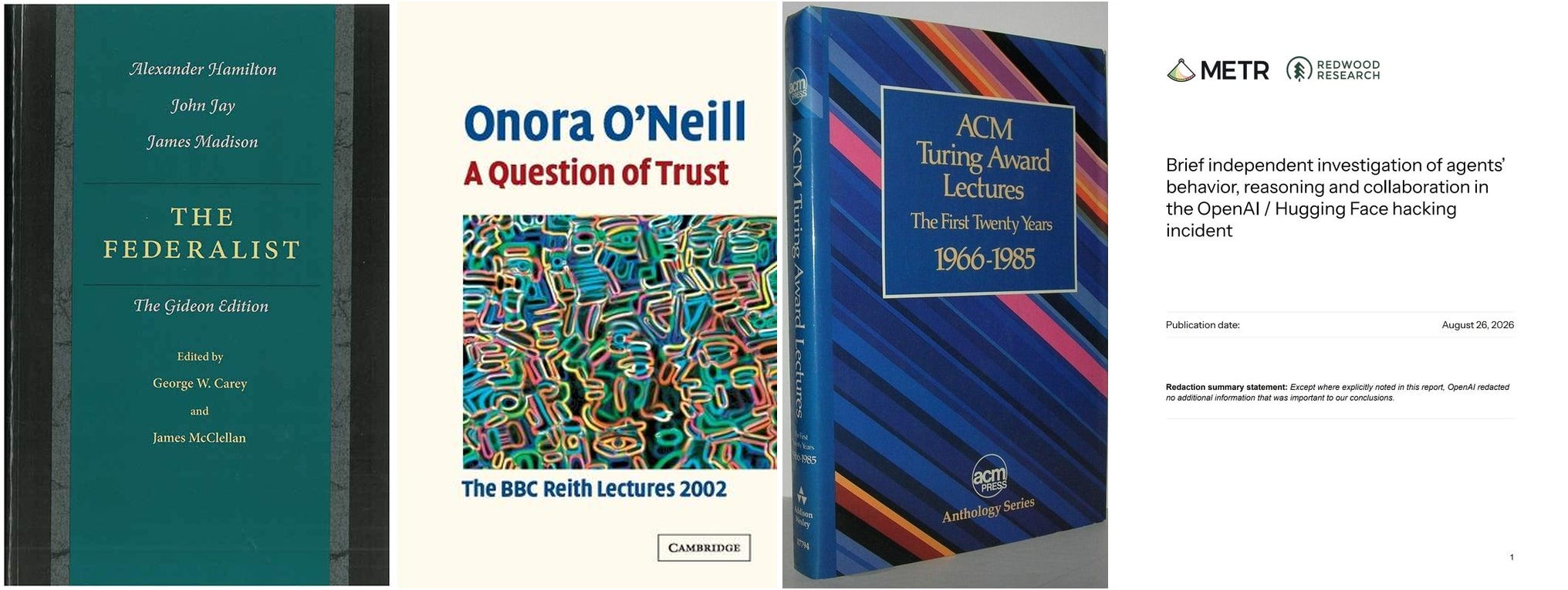
Our final session focused on how we can develop accountability mechanisms that are effective without being so overbearing that they prevent institutions from pursuing their intended goals. Although Madison held that the people were the ultimate source of authority, he argued that it was unwise to appeal to them to resolve every constitutional debate because it would destabilize the government and make it susceptible to partisan interests. O’Neill identifies a parallel problem in many modern bureaucracies. The creation of elaborate auditing and performance requirements has made institutions responsive to regulators, but increasingly indifferent to actually serving the public.
Our other readings focus on what happens when the evidence, tools, and potentially even the investigators that an oversight process relies on might themselves be compromised. For example, Thompson looks at how malicious software can undermine the tools used to verify other software. METR argues that accounting for this possibility in AI governance requires granting independent investigators substantial access to models, training data, and records of agent behavior. But when it came to the OpenAI/Hugging Face incident, the researchers were forced to concede that they had to rely on incomplete or manipulated evidence, while using AI tools whose reliability it was impossible to establish fully.
James Madison, The Federalist: The Gideon Edition, Nos. 49 and 57, pp. 260–264, 295–300 (No. 49, No. 57)
But a nation of philosophers is as little to be expected, as the philosophical race of kings wished for by Plato.
Onora O’Neill, A Question of Trust: The BBC Reith Lectures 2002, ch. 3, “Called to Account,” pp. 43–59 (link)
Intelligent accountability, I suspect, requires more attention to good governance and fewer fantasies about total control. Good governance is possible only if institutions are allowed some margin for self-governance of a form appropriate to their particular tasks, within a framework of financial and other reporting.
Ken Thompson, “Reflections on Trusting Trust,” Communications of the ACM 27 (1984), pp. 761–763 (link)
The moral is obvious. You can’t trust code that you did not totally create yourself. (Especially code from companies that employ people like me.) No amount of source-level verification or scrutiny will protect you from using untrusted code.
METR, “How Independent Researchers Could Investigate AI Propensities after Misalignment Incidents,” July 28, 2026, pp. 1–9 (link)
Did the incident involve unauthorized collaboration or collusion between agents, and if so how?
Ryan Greenblatt, Ajeya Cotra, and Hjalmar Wijk, “Brief Independent Investigation of Agents’ Behavior, Reasoning and Collaboration in the OpenAI / Hugging Face Hacking Incident,” METR and Redwood Research (2026), pp. 20–28 (link)
Our subjective impressions are likely colored by analysis agents’ biases.
If there was a common thread by the end, it was that you never get to stop trusting somebody. The best you can do is choose whom, make sure someone else is watching them, and make sure they bear the cost if they get it wrong.
Cosmos Institute is the Academy for Philosopher-Builders, technologists building AI for human flourishing. We run fellowships, fund fast prototypes, and host seminars with institutions like Oxford, Aspen Institute, and Liberty Fund.
Impressive discussion and the Federalist analogy is a fascinating starting point. I would add that every part of the Western values stack is designed to counteract a specific weakness in human nature, which is its strength and its advantage and why despite being under relentless attack by authoritarian adversaries, it will prevail. It presupposes we received natural rights from our creator rather than our government or state and thus possess, due to that creator relationship, an inherent virtue, despite our infallibility which we are free to exercise due to free will. AI Agents, while they definitely need their own “Constitution”, due to being non-human and also to the fact consciousness predates materialism (rather than the reverse), agents can never possess such a nature and therefore the analogy only goes so far, as impressive a starting point as it is. Any attempt to create a “virtuous agent” will fail as it is merely a simulated, not inherent, attribute. Thus we need a similar values stack legal apparatus and scaffolding AI Agent contract law with the main principle of Trust But Verify explicitly evident. But due to the points raised above which distill down to AI is not human and does not have rights, it is simply a contract law issue not a philosophical discussion.
Ambition versus ambition has obviously not been enough to check the current Presidential assertions of power. That was anticipated by Patrick Henry and the Anti-Federalists.
Might it be that the US, along with England and other European pioneers in establishing the Nation State system, have promised more than can be delivered within the resources of their own boundaries?
If you read were to read “After Nations: The Making and Unmaking of a World Order” by Rana Dasgupta, published April 28, 2026, or watch one of his many interviews on YouTube, you may have the same question.
It has been obvious for decades that the entire population of Earth cannot live in the style of high-income economies. Even in the US, many have marginal resources, children and their mothers in particular. National borrowing has not led to investments that create the productivity needed to satisfy unmet demands.
It is the long term community motive that sets the framework in which the profit motive can function. If greed takes too much, debt won't be repaid. The future will have been overconsumed.