


Liberal institutions promise broad access in principle and have remained viable because exercising those rights demands time and effort. Applying, appealing, objecting, requesting, complaining, and submitting all require exertion on the part of the citizen. This prunes the number of claims organizations must absorb, allowing them to deliver on their end of the bargain. As agents shrink that cost, institutions built for the old settlement are beginning to face the volume implied by their formal promises.
Nobel laureate economist Douglass North called institutions the “rules of the game” – artificially constructed constraints through which organizations interact such as laws or educational degrees. If technologies determine which actions are physically possible then institutions determine which actions are permitted and deemed reasonable within this space of potentialities.
Organizations are bound by these constraints, though they may also seek to modify institutions or generate new coordination structures from scratch. In the game of liberalism, North says institutions are rules and organizations players (though many other accounts close the gap between organizations and institutions proper). If a hospital is an organization, the rules governing access to appointments are an institution.
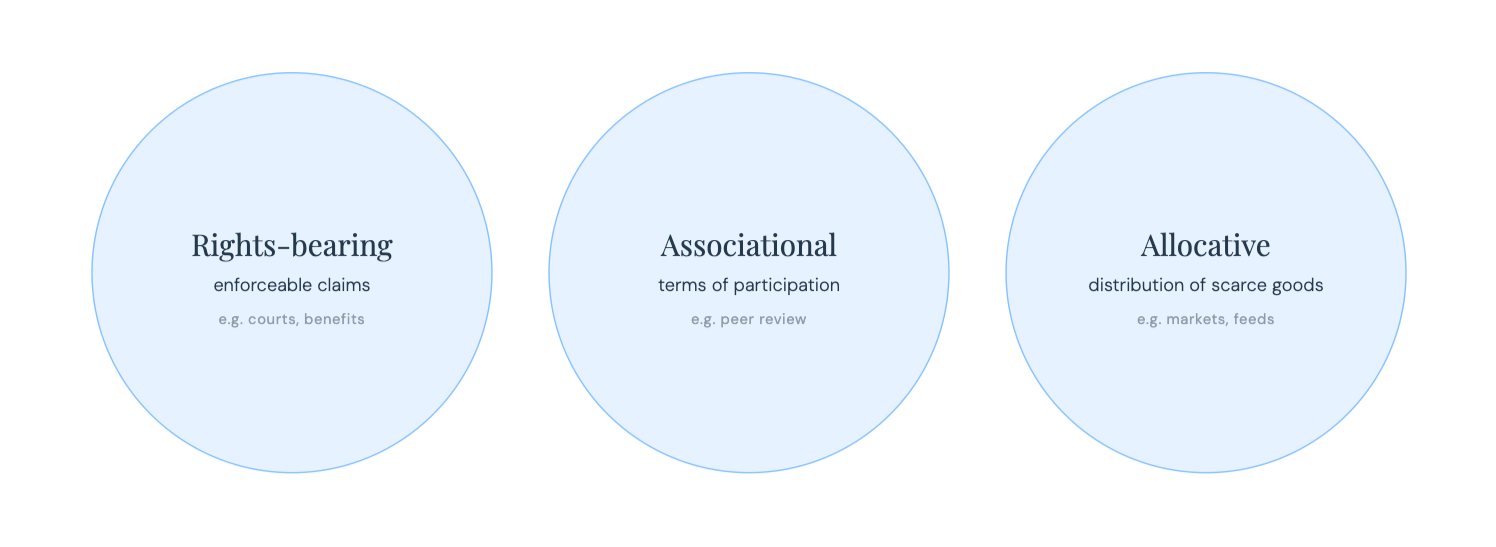
Within this model, there are three further kinds of institution: “rights-bearing” forms that give citizens enforceable claims such as court procedures or benefits eligibility systems; “associational” forms that govern participation in shared activities like a journal’s peer review process; and “allocative” forms that determine how scarce goods or information are distributed as in market standards or the reward function underpinning algorithmic feeds.
These social technologies are sophisticated machines that convert private information into public signals that others can view, contest, respond to, and use in whatever context seems best to them. A bachelor’s degree transforms ability into credentials an employer can recognize, just as peer review seeks to either reject independent claims or absorb them into the scientific canon. Even something as mundane as a queue is an institution of sorts.
At their best, liberal institutions are open on equal terms, produce decisions that can be contested, demand no more personal information than is necessary, and contain multiple centers of authority. Such a phenomenon represents a peculiar and unlikely feat, as multitudes of strangers recognize one another’s interests while remaining indifferent to underlying motivations.
These qualities are liberal institutions’ source of power and their greatest weakness. Freedom of information regimes are easy to game because they have to approach good and bad faith requests with the same seriousness. Government consultations can be spammed because they are obligated to consider an argument regardless of how spurious it appears. Openness to strangers means institutions cannot leverage personal relationships to sieve good inputs from the bad.
The rights-bearing settlement promised everyone a service in principle that it could not afford to deliver. Now it is struggling to pay its debts.
Solve for the equilibrium
A healthy institutional equilibrium is based on the assumptions that every act of engaging an institution costs time, that existing arrangements contain safeguards against people trying to game the system, and that both citizen and organization work at the same speed.
This settlement started failing long before the introduction of powerful AI systems. Contemporary institutional malaise is a product of bad proxies, the accumulation of red tape, capture by well organized groups, and the introduction of destabilizing new technologies. One essential factor concerns a reduction in costly effort, the time or skill that a person must expend in order to successfully engage an institution.
This can be to apply, appeal, object, request, complain, submit, or whatever else the machinery of bureaucracy empowers us to do. The existence of costly effort reduced the number of claims that organizations had to consider by reducing numbers to a manageable size. The recent past is replete with examples of technology dampening the cost of playing by the rules. When existing equilibria begin to falter, new ways of doing are introduced to better mediate between organization, technology, and citizen.
In the 1980s and early 1990s, junk faxing became severe enough that the United States legislated against it in 1991. When email emerged as a dominant form of digital communication, by the middle of the 2000s the majority of sent messages were spam. Again, new modes of practice were helped on by a cocktail of regulatory responses, filtering mechanisms, and sender authentication standards. CAPTCHA appeared around the same time as an access gate designed to prevent bots from abusing online services intended for humans.
In February 2026, the president of Australia’s Fair Work Commission projected that by the end of the financial year, its total workload will have increased by more than 70 percent in three years. The principal explanation, in his view, was increasing use of AI tools by potential litigants. A 2026 MIT/USC working paper covering more than 4.5 million non-prisoner federal civil cases found that the share filed by self-represented litigants rose from a long-run average of 11 percent to 16.8 percent in FY2025. Total docket entries per court generated by those cases in their first 180 days were 158 percent above the pre-AI mean by Q2 2025.
The introduction of a sufficiently disruptive form of technology sees citizens and organizations faced with new patterns of behavior or the amplification of existing modes of engagement that the current ruleset cannot accommodate. At this point established practices face a crisis in the medical sense: the patient either dies or recovers. Liberal institutions may be brittle, but liberalism is not. Its power lies in allowing citizens to create new structures when the old can no longer sustain meaningful cooperation on open and equal terms.
Recursive self-obsolescence
Agents need not introduce wholly new behaviors that organizations must be forced to adopt. For the most part, novelty flows from forms of delegation in which a person specifies a goal and an agent selects the specific actions required to achieve it. In the famous case of an agent canceling someone else’s gym booking in order to free up a spot for its principal, neither jumping a queue nor API exploitation is a new behavior. The novel aspect concerns a mode of delegation in which a principal issues instructions and an agent acts on them without supervision.
Both principal-agent dynamics and the amplification of existing behaviors upset the costly effort equilibrium. Hacking a booking system used to be hard work. Now, anyone with access to a sufficiently powerful (and permissive) model can do it. Agents reduce the cost of doing, whether it be legitimate assistance or arbitrage, allowing familiar actions to play out at far greater scale and unfamiliar actions to occur more frequently.
Citizen adoption of AI is currently outpacing that of most organizations. Sophisticated agents are not yet ubiquitous, but a potential reduction in effort is in some sense a good thing. The effort to engage often excludes those with legitimate claims, so reducing it can help an institution fulfill its stated purpose. Organizations can also benefit from receiving clearer and more complete engagements.
But, at least in the context of rights-bearing institutions, the ability to draft requests more easily and identify grounds for appeal is not always in the citizen’s best interest. Citizens are acting on promises that were affordable because most people never tried to fulfill them. Once this happens, submission volumes rise and individual applications become longer and more detailed. Weak claims become harder to distinguish from strong claims as agents raise the baseline quality of all applications.
Organizational performance eventually declines as backlogs swell and response times lengthen. Staff, or perhaps their agents, respond by spending more time checking submissions and so decisions become more hurried or, in the case of agentic solutions, automated. Naturally, citizens respond by asking their agents to send another follow up request or duplicate the claim in full. They appeal decisions they don’t like because the cost of doing so is negligible.
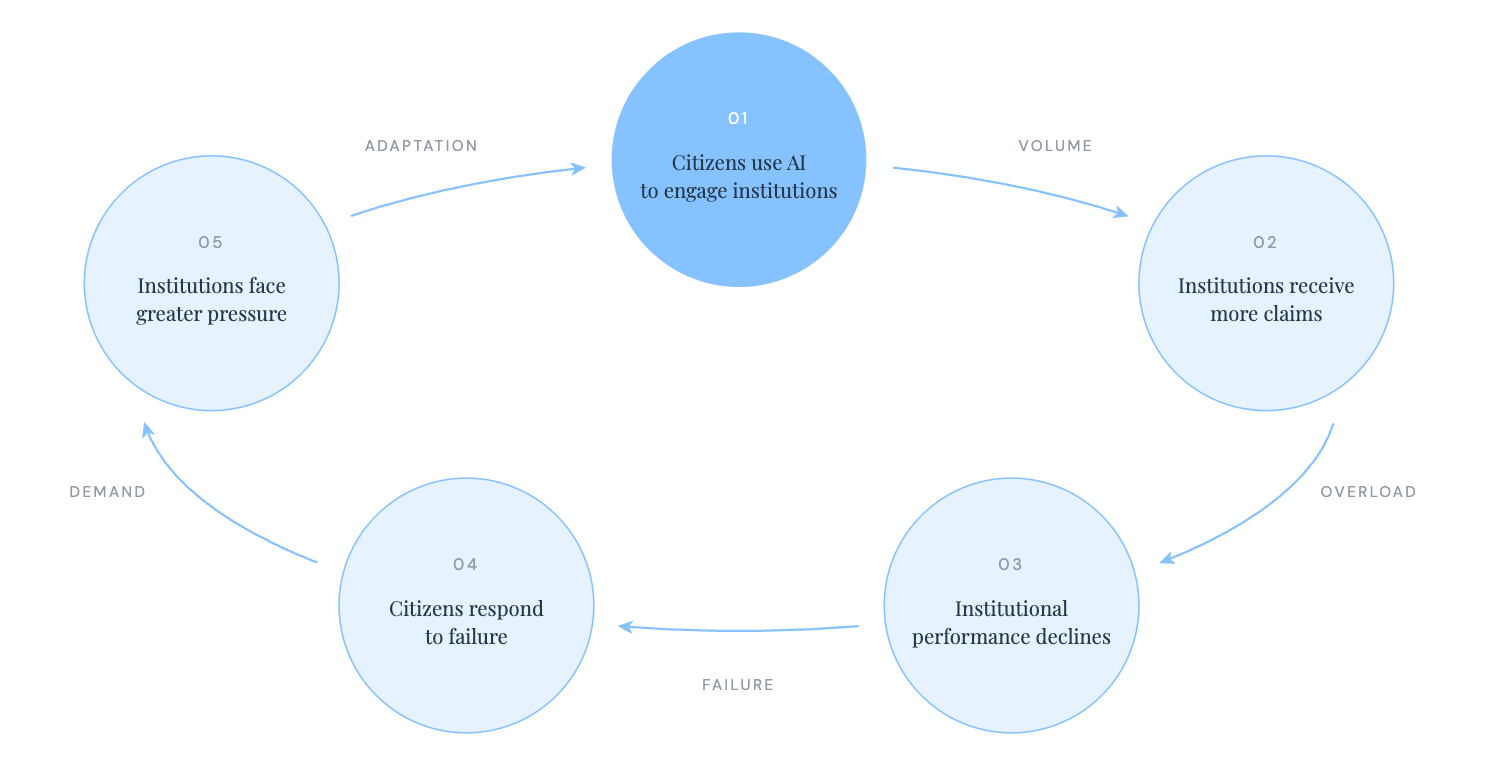
The result would look like a gumming up of institutional machinery as follow-ups exacerbate backlogs, appeals create more work, automated decision-making requires human oversight to avoid costly mistakes, and those mistakes that inevitably do happen create further appeals.
This outcome depends on the extent to which the “offensive” (taking an action e.g. making a claim) versus “defensive” (responding to an action e.g. resolving a claim) qualities are likely to win out in the context of symmetric AI adoption. Assuming AI makes each cheaper, the offense win condition is met if claims grow faster than the cost of processing them falls (and vice versa for defense).
If the victory condition is determined by whether the number of actions multiplied by the average work each requires exceeds organizational capacity, the case for offense rests on the diffusion of systems throughout the population and an inability of organizations to triage engagement. With widespread access, citizens face almost no limit on how many actions they can initiate or re-initiate.
On the defensive side, agents may help organizations process claims faster. Software vulnerabilities exposed by a citizen’s agent need only be patched once. Duplicate submissions can be easily filtered out and standard requests can receive cookie-cutter answers delivered automatically. Defense is strongest when one change handles many future actions of the same kind and weakest when every action requires a new assessment.
For associational institutions, there are instances like peer review where organizations have greater freedom to change the conditions of participation, creating relatively strong defensive options. Nobody has a right to have a paper reviewed or published, so a journal can impose whatever conditions on submission it deems to be reasonable. Peer review also deals with stable objects that can be used as chokepoints for assessment and sanctions when necessary.
As for allocative institutions, a booking system determines how a fixed number of available slots is best distributed among people seeking to make an appointment. When agents can monitor cancellations and submit bookings faster than people can, a first-come-first-served approach begins to allocate according to the effectiveness of automation rather than time of arrival in a strict sense. The organization administering the queue may respond by limiting requests or verifying identities or even introducing a lottery.
Compare these to rights-bearing institutions like a benefits application process, which cannot clearly and easily ban AI-assisted claims. A claimant may need help understanding the application process or need assistance in navigating a user portal. Taking a harder line on AI assistance would require major departures from the current assumptions these institutions rest on.
Renewing liberalism
In the coming years, organizations faced with ballooning volumes of activity will have three kinds of responses available to them: expand capacity, redesign approaches, or restrict access. Most will do some of each, though the exact form this settlement takes will depend on which kinds of institutional life (e.g. rights-bearing, associational, or allocative) a specific organization is concerned with.
A single organization may even deal with all three kinds at the same time. An organization may, for example, automate routine engagement while changing the methods by which it assesses certain types of input, possibly even going so far as to curtail some forms of access. A journal could automate screening and formally prohibit the use of AI-generated text, while a university might automate routine administration and replace personal statements with in-person interviews.
The rub is that such responses threaten the liberal institutional philosophy. Fees restore equilibrium by wealth, and request caps can be equal in form while treating claims with very different stakes in the same way. Robust identity verification measures make agents harder to deploy, but require more personal information as part of the bargain. Lotteries preserve equal standing where claims are equivalent, though they are blind to merit or need.
Prioritizing along these lines may track the purpose of the institution more closely, but create more judgments to contest and can concentrate authority in the hands of whoever assesses claims. Expanding capacity may seem like a get out of jail free card, but escapes these tradeoffs only where processing can scale at least as quickly as claims.
Costly effort is a contingent fact about human action that happened to make liberal promises administrable. The advent of capable agents exposes this hidden constitution, and so institutions must find a new settlement under which citizens can participate in liberal society. Any replacement must attempt to navigate equal access, contestability, minimal necessary information, and plural authority.
Liberal institutions are not invincible, but that is precisely the point. Its institutional order can be replenished by people who notice an exhausted settlement and work toward the next. We may not know what the next “rules of the game” will be, but we do know that liberalism lets us write them.
Great article. I've been noticing this happening myself as well. This effort asymmetry is popping up all over the place, even in the corporate world, where people will send long Claude generated documents that they have not even read themselves but expect the recipients to. If there is an error, they will blame the AI or request feedback, which they will then put into the AI.
In a sense, social relations run on costly signals. If someone makes a very polished slide deck, it's not just for the aesthetics of the recipient, it's a costly demonstration of effort and diligence, which presumably carries over to other aspects of the relationship. If you spend a lot of effort making a gift, even if it is not as good as one could buy, "it's the thought that counts."
Everything is “dead” and yet so much lingers on, like a zombie. Life and aliveness will require some updates 🫡