

Technology has long constrained organizational design. To compensate for our natural inability to coordinate complex work at scale in real time, we have developed structures that make coordination possible, such as reporting hierarchies, information compartmentalization, project planning rhythms, and role scopes.
If AI agents are able to absorb information from across an organization, represent preferences accurately, and negotiate agreements at next to no cost, much of this structure might become unnecessary. Agents could dramatically expand what we’re able to accomplish by negotiating, coordinating, and executing at a scale far beyond any individual’s bandwidth.
Organisations that redesign themselves around agents could become far more productive. But individuals could become more isolated, and spend less time forming and exercising their own judgment. How organizations manage this tension between increasing collective productivity and sustaining individual critical faculties could have sweeping consequences for the economy and the experience of work.
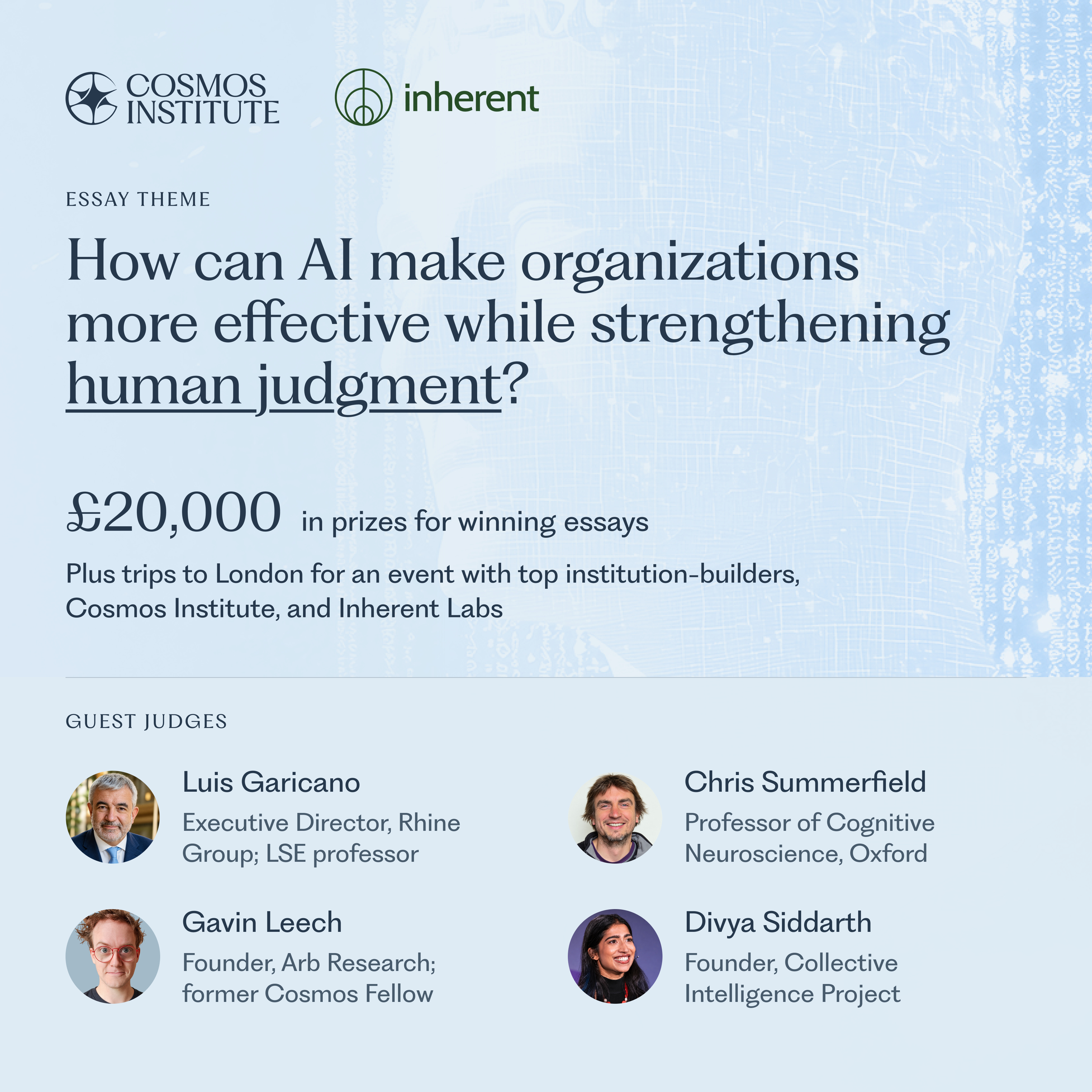
We’re delighted to be partnering with Inherent for an essay prize that asks how we can create organizations that make the most of AI agents, while also deepening human autonomy and fulfillment. Inherent is a new London-based AI lab building collaborative agents for scientific discovery.
We are looking for essays of no more than 1,000 words on one of the following two prompts:
How can AI address a specific coordination problem that has historically dogged human organizations? What would adopting this solution mean for the organization’s structure and the day-to-day experience of individuals within the organization?
Describe a specific AI system that, when implemented in an organization, would simultaneously strengthen the operation of human judgment whilst increasing organizational performance.
Essays should be submitted here by a deadline of EOD Sunday November 8th. We will then select and notify the 2-3 winners by November 17th, and would look to publish the winning entries.
Essays will be judged by:
Luis Garicano, the Executive Director of Rhine Group, and Professor Of Public Policy at LSE. He is the co-author of the recent book Messy Jobs: The Work That AI Cannot Reach and writes regularly at Silicon Continent, a Substack focused on AI, innovation, and growth.
Chris Summerfield, Professor of Cognitive Neuroscience at the University of Oxford and Research Director at the UK AI Security Institute. Chris focuses on how advancing our knowledge of human cognition can advance AI and has written about how AI can enhance deliberation among people.
Gavin Leech, Founder and Managing Partner at Arb Research, a consultancy focused on original research, evidence gathering, and building data pipelines for AI, policy, and forecasting projects. He is the co-author, along with Dwarkesh Patel, of The Scaling Era: An Oral History of AI, 2019-2025.
Divya Siddarth, Co-Founder and Executive Director at the Collective Intelligence Project, a non-profit designing democratic governance models and decision-making technologies for AI. Divya is currently on the Alignment Team at Anthropic, working on preventing risks to democracy from AI.
The judges will focus on whether proposals are practical, specific, and scaleable, rather than style of prose.
Inherent is funding £20,000 in prizes. The top entry will receive £10,000 and the chance to spend a week working with Inherent to bring their idea to life at the heart of a real research organisation. Runners up will receive £5,000 each.
All winners will be invited to attend an event in London, with the costs of their travel covered, to meet Inherent and Cosmos, along with thinkers and builders in our network.
Cosmos Institute is the Academy for Philosopher-Builders, technologists building AI for human flourishing. We run fellowships, fund fast prototypes, and host seminars with institutions like Oxford, Aspen Institute, and Liberty Fund.
Inherent is a new London-based AI lab. They are building AI scientists that thrive in open-ended areas of research, where there is no single best next step. They think working with AI scientists will require a complete research process redesign, and so are also building the infrastructure for new kinds of human-machine teaming. They call this ‘living with the experiment’. You can join the experiment here.